

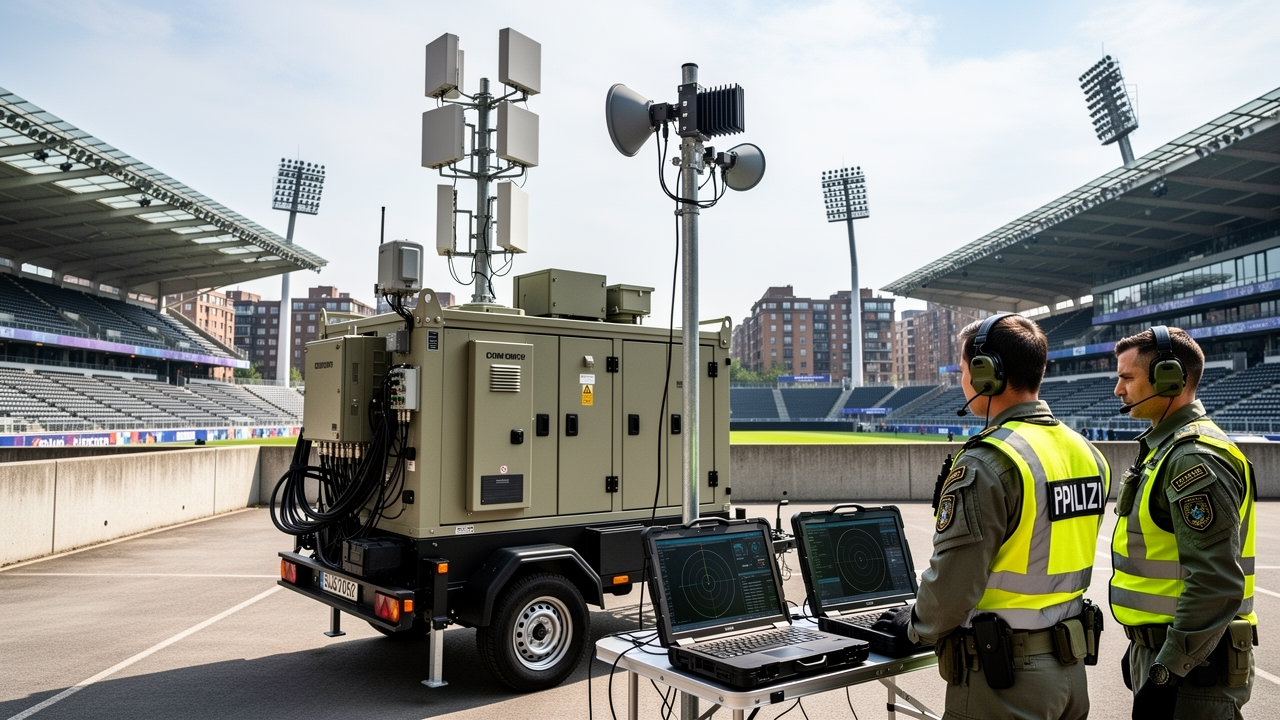
Securing Large Events: The Critical Role of 400M Instantaneous Bandwidth Signal Generator in Counter-UAS
Introduction
Recently, the US Federal Emergency Management Agency FEMA announced a grant of up to $250 million to local governments specifically for ensuring the security of Counter-UAS C-UAS systems during the 2026 FIFA World Cup. This significant investment highlights the growing global concern over drone threats, especially concerning large public events and critical infrastructure protection. Unauthorized drones can pose various threats, from espionage to potential terrorist attacks, making reliable and efficient counter-UAS solutions crucial.
Industry Challenges & Pain Points
Currently, drone technology is developing rapidly, with its application scenarios and performance continuously advancing. This presents significant challenges to traditional defense methods. For instance, small commercial drones are easily acquired and can fly in complex environments, making them difficult to detect effectively by traditional radar or visual systems. More importantly, drone communication frequencies and control protocols are becoming increasingly diverse and complex. Traditional fixed-frequency or narrowband jammers often struggle to effectively counter such wideband, multi-mode threats. Existing counter-UAS systems face issues such as frequency rigidity, slow response times, and an inability to cover all potential threat frequency bands.
The Core Countermeasure: Why Signal Interference Source is Key
In Counter-UAS C-UAS systems, the signal interference source equipment is considered its core component. Effective countermeasures are not just about detection and tracking, but more about reliably cutting off or interfering with a drone’s control signals, navigation signals, or video downlink signals. To address evolving drone threats, a high-performance signal interference source must possess wideband coverage capabilities and rapid frequency hopping agility. Only by covering a broad spectrum range from low to high frequencies and quickly adjusting interference frequencies according to the threat type can comprehensive and effective suppression truly be achieved.
Advanced Solution: 400M Instantaneous Bandwidth Signal Generator
Facing these challenges, we recommend the 400M Instantaneous Bandwidth Signal Generator as a core component for high-performance Counter-UAS C-UAS solutions. This signal generator possesses the following key features:
- Ultra-wide frequency range: 70-6000MHz, capable of covering almost all known drone operation and communication frequency bands, including civilian, commercial, and even some military frequencies.
- High instantaneous bandwidth: Its 400MHz instantaneous bandwidth enables it to simultaneously generate complex interference signals across a broad spectrum, effectively countering multi-target or wideband frequency-hopping drones.
- Software-defined frequency modulation: Flexible configuration and rapid switching of interference frequencies and modes via software allow it to quickly adapt to evolving drone threats and unknown frequency bands.
- Application scenarios: Highly suitable for public event security, military base protection, border patrol, and critical infrastructure protection, where high counter-UAS capabilities are required.
Conclusion
The 2026 FIFA World Cup counter-UAS grant event clearly indicates the urgent global demand for effective C-UAS solutions. To counter future drone threats, the key lies in deploying advanced signal interference sources equipped with wideband coverage, high instantaneous bandwidth, and software-defined frequency modulation capabilities. The 400M Instantaneous Bandwidth Signal Generator is precisely such an ideal solution, providing powerful support for establishing safer and more reliable defense systems.
Contact us today to learn how the 400M Instantaneous Bandwidth Signal Generator can enhance your counter-UAS system capabilities.
FAQ
Question 1: What is the significance of instantaneous bandwidth in counter-UAS applications?
Answer 1: Instantaneous bandwidth refers to the frequency range a device can process or cover simultaneously. In counter-UAS C-UAS applications, high instantaneous bandwidth means the signal generator can simultaneously create multiple interference signals across a broad spectrum, effectively countering drones that use techniques like frequency hopping and spread spectrum, thereby increasing interference success rates.
Question 2: How does software-defined frequency modulation enhance the adaptability of counter-UAS systems?
Answer 2: Software-defined frequency modulation allows users to quickly modify and adjust interference signal parameters like frequency, power, and modulation scheme via software, without needing hardware changes. This enables counter-UAS systems to rapidly adapt to newly emerging drone communication protocols or unknown operating frequency bands, providing highly flexible and upgradeable defensive capabilities.
