

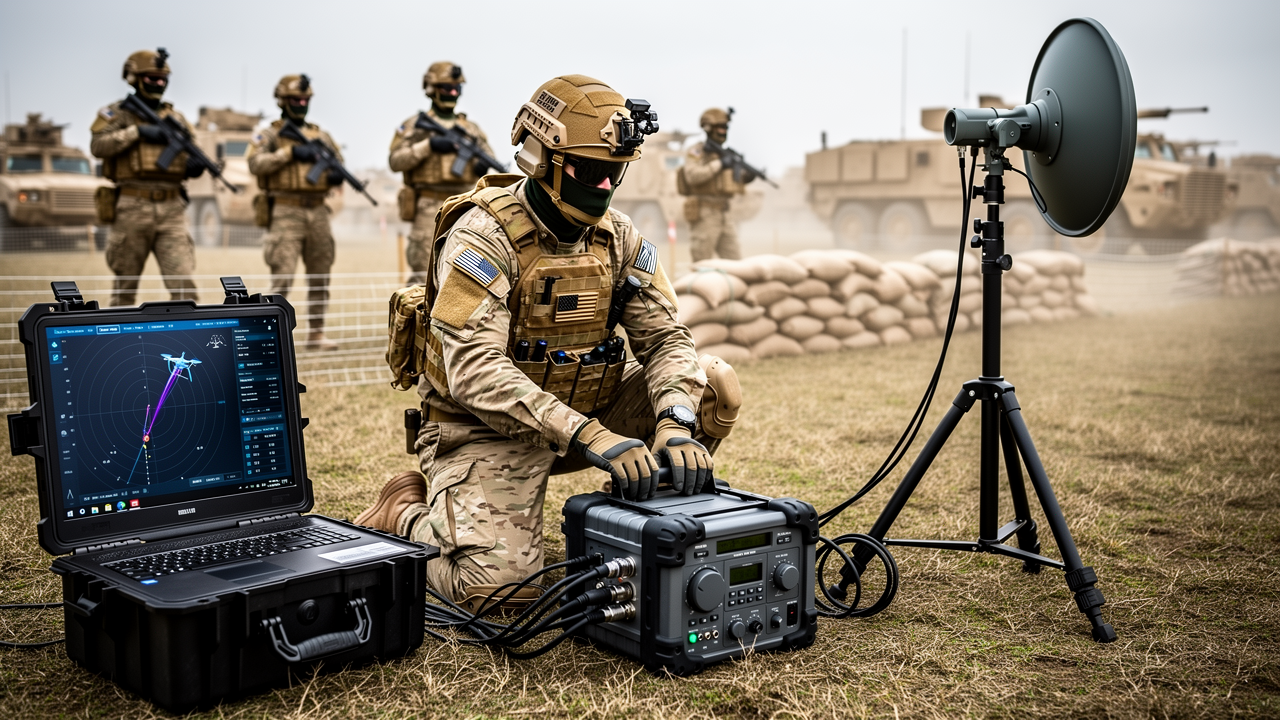
New Developments in Counter-UAS Systems: Strategic Value of the 400M Instantaneous Bandwidth Signal Generator
Introduction
The US Federal Emergency Management Agency FEMA recently announced regional Counter-Unmanned Aircraft Systems (C-UAS) grant awards. This move signifies a significant step in addressing growing drone threats at the local level across the United States. These funds are intended to enhance the defensive capabilities of local agencies against security challenges posed by unauthorized drone activities. This initiative reflects the government high priority on protecting critical infrastructure and public safety, while also heralding new development opportunities for the counter-UAS technology market.
Industry Challenges & Pain Points
Currently, drone technology is developing rapidly, with its applications expanding from civilian entertainment to potential threat activities, including illegal reconnaissance, smuggling, and malicious intrusion targeting sensitive areas. Traditional defense methods often face limitations such as fixed frequencies, slow response times, and difficulty covering a wide spectrum. Especially when confronting multi-band, frequency-hopping, or swarm drone attacks, existing countermeasures often prove inadequate, struggling to effectively detect, identify, and suppress these complex threats. To effectively counter these evolving aerial threats, more adaptive and powerful solutions are required.
The Core Countermeasure: Why Signal Interference is Key
In counter-UAS strategies, an effective signal interference source is critical for suppressing drone communication and navigation links. A powerful jamming source can sever the connection between a drone and its operator, or disable its Global Positioning System (GPS) signal, thereby forcing it to return, land, or lose control. The core to achieving such effective interference lies in possessing wideband coverage capability and rapid frequency adaptability. Only by doing so can the diverse communication frequency bands used by different types of drones be addressed, and rapid adjustments made to counteract advanced technologies like frequency agility, providing a solid guarantee for counter-UAS systems.
Advanced Solution: 400M Instantaneous Bandwidth Signal Generator
To meet these stringent counter-UAS requirements, we recommend the 400M Instantaneous Bandwidth Signal Generator. This device stands out as an ideal choice due to its exceptional performance. It offers an ultra-wide frequency range of 70-6000MHz, capable of covering almost all known and potential drone communication bands. More importantly, its 400M instantaneous bandwidth capability ensures efficient simultaneous interference across a wide spectral range. Combined with software-defined frequency modulation capabilities, this device can intelligently adjust interference strategies based on real-time threats, enabling rapid deployment and flexible response to effectively neutralize complex drone threats, significantly enhancing the overall effectiveness of counter-UAS systems.
Conclusion
FEMA grants and increasingly complex drone threats collectively highlight the urgency for advanced counter-UAS system solutions. A signal generator equipped with wideband, high instantaneous bandwidth, and software tunable capabilities is precisely the core tool for addressing current and future drone challenges. Investing in such technology is crucial for ensuring the security of critical areas and forms the cornerstone of building a robust airspace defense system.
Contact us today to learn more about how the 400M Instantaneous Bandwidth Signal Generator can strengthen your defensive capabilities.
FAQ
Question 1: How does the 400M Instantaneous Bandwidth Signal Generator improve counter-drone effectiveness?
Answer 1: It significantly enhances countermeasure effectiveness by providing wide frequency coverage from 70-6000MHz and 400M instantaneous bandwidth, enabling simultaneous interference of multiple drone communication bands and rapid adaptation to threat changes via software tunable capabilities.
Question 2: What are the advantages of the software tunable feature?
Answer 2: Software tunable functionality allows the device to automatically or manually adjust interference signals based on real-time detected drone frequencies, ensuring precise and effective jamming, especially against frequency-hopping or unknown frequency band drones, offering unparalleled advantages.
