

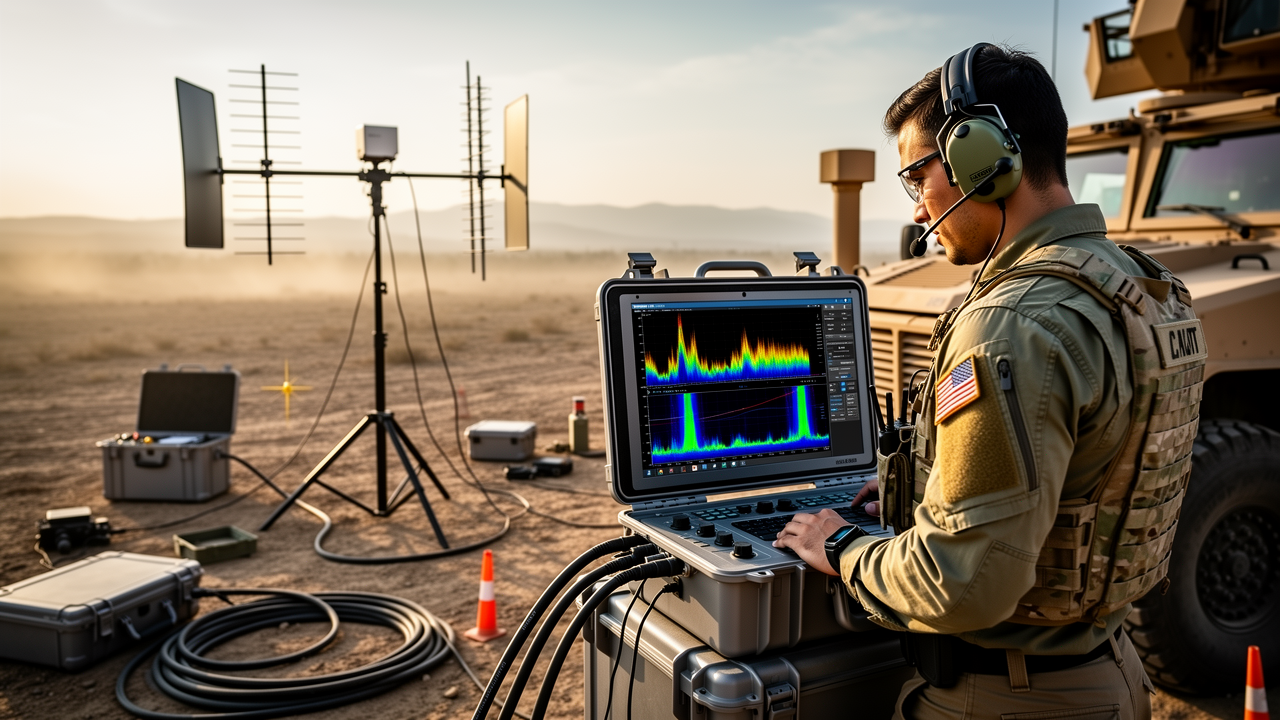
400M Instantaneous Bandwidth Signal Generator: Core Weapon for Counter-UAV Wideband Jamming
Introduction
Recent news: Babcock and Frankenburg companies recently signed a strategic Memorandum of Understanding (MoU) aimed at strengthening collaborative development and integration in the defense systems sector. This move highlights both giants shared vision in addressing future security challenges. The current global geopolitical landscape is complex, with asymmetric threats growing daily. In particular, faced with the rapid advancement of UAV technology and its misuse in both military and civilian domains, nations increasingly demand advanced defense technologies. This partnership aims to build stronger defense capabilities through the integration of leading technologies.
Industry Challenges & Pain Points
Unauthorized unmanned aerial vehicles (UAVs), including small consumer drones and more complex UAV systems, pose serious threats to critical infrastructure, military bases, and public safety. These UAVs can be used for reconnaissance, carrying dangerous payloads, or even launching attacks. Traditional countermeasures are often limited by fixed frequencies or narrowband jamming capabilities, making it difficult to effectively counter wideband, multi-modal, and constantly evolving UAV communication and navigation systems. The rapid iteration of UAV technology leaves existing defense systems struggling with slow reactions and inadequate coverage.
The Core Countermeasure: Why Signal Interference Source is Key
In counter-UAV systems, the signal interference source, commonly known as a jammer, is the most critical component for neutralizing UAV communication and navigation capabilities. By emitting high-power jamming signals, it can sever the link between the UAV and its operator, preventing it from receiving commands or deviating from its intended course, thereby effectively thwarting its mission. Effective UAV countermeasure systems must possess wideband jamming capability and frequency agility. Wideband capability ensures coverage of UAV communication across different frequency bands, while frequency agility allows the system to quickly adjust jamming frequencies to adapt to UAV frequency hopping or newly emerging threats.
Advanced Solution: 400M Instantaneous Bandwidth Signal Generator
To address the aforementioned challenges, we proudly introduce the 400M Instantaneous Bandwidth Signal Generator, whose exceptional performance makes it an ideal core component for counter-UAV systems. This device not only offers broad frequency coverage and instantaneous bandwidth, but its software-tunable feature also provides the system with extreme flexibility and upgrade potential, enabling it to continuously adapt to future UAV technology advancements.
Key Parameters:
- Frequency Range: 70-6000MHz, achieving comprehensive coverage of mainstream UAV communication and navigation frequency bands.
- Instantaneous Bandwidth: Up to 400MHz, ensuring effective jamming across a wide spectrum in extremely short times, countering advanced threats like frequency hopping.
- Software-Defined Frequency Modulation: Supports software-defined frequency modulation, allowing users to flexibly configure and rapidly switch between multiple jamming modes to adapt to evolving threat scenarios.
- Output Power: 0dBm ~ 20dBm
- Harmonic: <-10dBc
- Frequency Switching Time: <5ms
- Power Supply: DC+12V
- Dimension: 120 x 80 x 20mm
- Weight: <1kg
Conclusion
The collaboration between Babcock and Frankenburg, combined with advanced technologies such as the 400M Instantaneous Bandwidth Signal Generator, collectively paints a new picture for future national defense and security. It emphasizes the decisive role of technological innovation in confronting modern asymmetric threats, especially in the counter-UAV domain.
Contact us today to learn how the 400M Instantaneous Bandwidth Signal Generator can enhance your national defense security solutions.
FAQ
Question 1: What are the main application scenarios for the 400M Instantaneous Bandwidth Signal Generator?
Answer 1: It is primarily used in counter-UAV systems, electronic warfare, radar simulation, wireless communication testing, and R&D areas requiring wideband signal generation and jamming.
Question 2: What are the specific advantages of the devices software-defined frequency modulation function?
Answer 2: The software-defined frequency modulation function allows users to quickly configure and switch between various modulation modes, frequencies, and bandwidths via software, greatly enhancing the systems flexibility and adaptability in confronting complex and unknown threats, while reducing hardware upgrade costs.
