

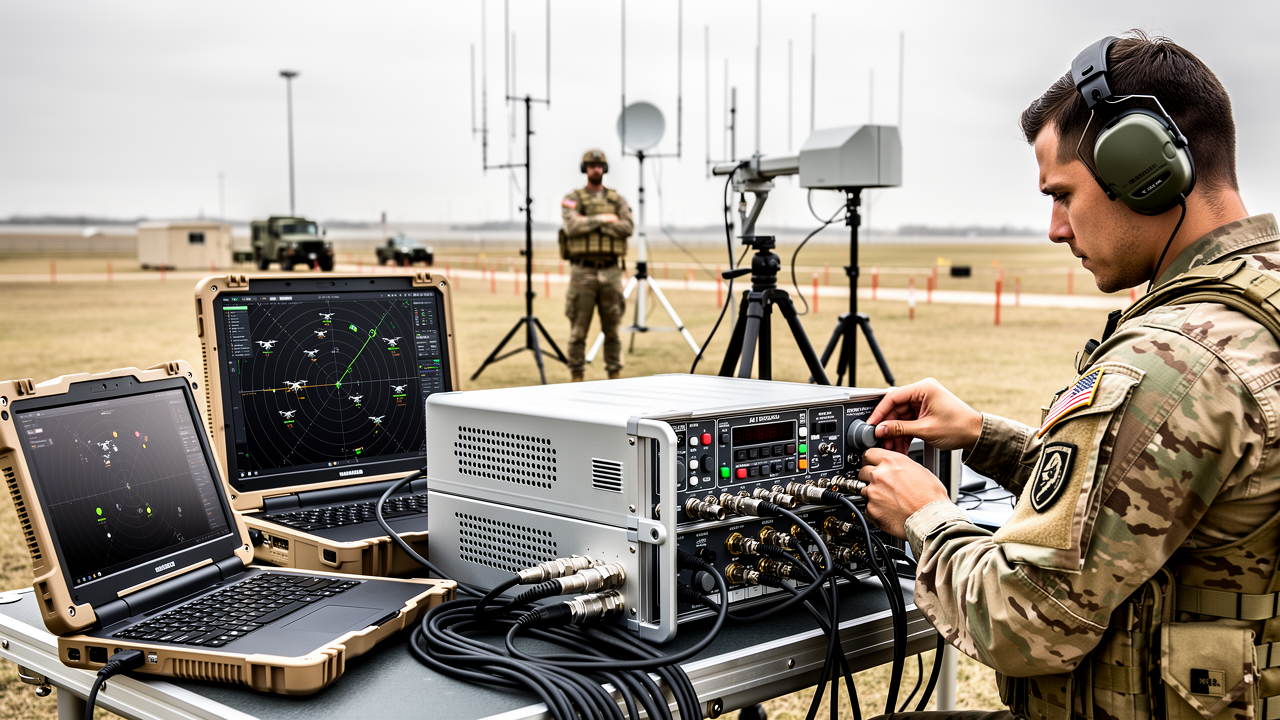
NDAA 2026 and the Future of Counter-UAS Systems: How the 400M Instantaneous Bandwidth Signal Generator Meets Challenges
Introduction
New provisions for Counter-UAS C-UAS in the US National Defense Authorization Act NDAA 2026 are casting uncertainty over previously bipartisan-supported legislation. This reflects the urgent need for enhanced C-UAS capabilities and continuous adjustments to existing frameworks as the US confronts increasingly complex drone threats. These regulatory updates aim to strengthen federal agencies and local law enforcement authorities in detecting, identifying, and countering unauthorized drones, signaling a critical period for the development and application of counter-drone technology.
Industry Challenges and Pain Points
With the proliferation of drone technology, especially civilian and commercial drone platforms, risks of illegal intrusion, espionage, and even potential attacks are growing. Traditional countermeasures often rely on specific frequencies and fixed power, proving inadequate against frequency hopping, multi-drone coordination, and wideband stealth drone threats. Current counter-UAS systems face challenges such as slow response times, limited coverage, and insufficient ability to contend with complex electromagnetic environments. This necessitates more advanced and flexible jamming technologies to effectively protect critical infrastructure and personnel safety.
Core Countermeasure: Why the Signal Interference Source is Key
In counter-drone strategies, the signal interference source is the core element that directly disrupts drone control and navigation capabilities. An efficient signal interference source must possess broad spectrum coverage and rapid frequency hopping adaptability. It can cause drones to lose control or be forced to land by suppressing their remote control signals, GNSS navigation signals, or video transmission signals. The wider the instantaneous bandwidth and the more flexible the frequency switching, the greater its ability to combat various drone models, multi-band threats, and complex electromagnetic environments.
Solution: 400M Instantaneous Bandwidth Signal Generator
To address the challenges of future counter-UAS systems, our company proudly introduces the 400M Instantaneous Bandwidth Signal Generator. This device is specifically designed for highly dynamic, wide-spectrum environments, with core advantages including:
- Ultra-wide Frequency Range: Covering 70MHz to 6000MHz, it can comprehensively cover all major frequency bands likely to be used by current and future drones.
- 400MHz Instantaneous Bandwidth: Its substantial instantaneous bandwidth ensures the device can simultaneously jam multiple frequency bands or switch rapidly, effectively suppressing wideband frequency hopping drones.
- Software Tunable Frequency: Leveraging Software Defined Radio SDR technology, users can flexibly configure jamming strategies and frequencies based on real-time threat types and environmental requirements, enabling rapid deployment and response.
This signal generator not only provides powerful jamming capabilities but also, with its flexibility and upgradeability, becomes an ideal choice for building next-generation counter-UAS systems.
Conclusion
Facing evolving drone threats and regulatory updates, counter-UAS systems are encountering unprecedented development opportunities and challenges. Choosing a signal generator with wideband, large bandwidth, and software tunable characteristics is crucial for ensuring effective defense and future technological upgrades. The 400M Instantaneous Bandwidth Signal Generator is designed precisely for this need, providing robust technical support for global security and defense.
Contact us today to learn how the 400M Instantaneous Bandwidth Signal Generator can enhance your counter-UAS capabilities.
FAQ
Question 1: What are the primary applications of the 400M Instantaneous Bandwidth Signal Generator?
Answer 1: It is primarily used in scenarios requiring wideband, high-precision signal generation, such as counter-UAS C-UAS, electronic warfare ECM, radar simulation, and radio communication testing.
Question 2: What advantages does the software tunable frequency feature offer?
Answer 2: The Software Defined Radio SDR feature allows users to quickly change frequencies, modulation schemes, and output power based on real-time threats and mission requirements, achieving extremely high flexibility and adaptability to effectively counter evolving threat spectrums.
