

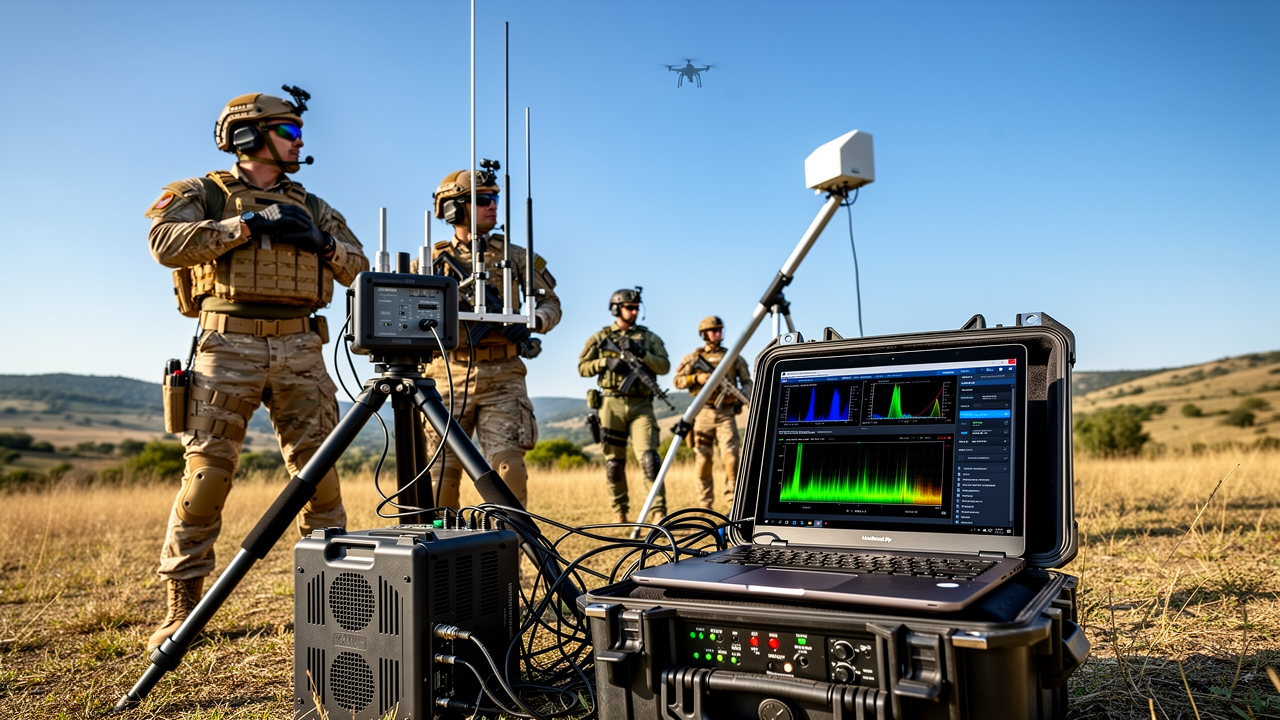
Addressing Future Drone Threats The Critical Role of Wideband Signal Generators in Counter-UAV Operations
Introduction
Recent news indicated that no single weapon can defeat all drone threats. This assertion highlights the complexity and dynamic nature of modern drone warfare. As drone technology rapidly advances, its applications, from reconnaissance to attack, are becoming increasingly widespread and diversified. Traditional defense methods face significant challenges, as adversary drones may employ swarm attacks, frequency hopping, or complex evasion strategies. This signifies that counter-UAV strategies must shift from single solutions to integrated, flexible systems.
Industry Challenges & Pain Points
The current defense sector faces growing drone threats. Unauthorized drone activities pose serious risks to military bases, critical infrastructure, and even civilian airspace. Existing counter-UAV methods are often limited by fixed frequencies, slow response times, or insufficient coverage. Confronted with wideband, multi-band, or even AI-driven drones, traditional interference or kinetic interception methods based on specific frequencies prove inadequate. The coordinated attacks of drone swarms and their rapid frequency adaptability necessitate that defense systems urgently enhance their flexibility and broad-spectrum coverage capabilities.
The Core Countermeasure: Why Signal Interference is Key
Among the various strategies for counter-UAV systems, the signal interference source is a core component. By effectively blocking or jamming communication and navigation signals between drones and their operators, drones can lose control, deviate from their course, or even crash, thereby achieving non-contact soft kill. To achieve such effective interference, the signal interference source must possess wideband coverage capability and frequency agility. Wideband capability ensures coverage of various frequency bands drones may use, while frequency agility allows the system to quickly adapt to adversary frequency hopping or discover new threat frequencies. This makes signal interference an indispensable key technology for addressing complex drone threats.
Advanced Solution: 400M Instantaneous Bandwidth Signal Generator
To effectively address the aforementioned challenges, the 400M Instantaneous Bandwidth Signal Generator offers an ideal solution. This device features an ultra-wide frequency range of 70-6000MHz, ensuring coverage of most commercial and military drone communication and navigation bands. Its core advantage lies in its 400M instantaneous bandwidth, allowing the device to simultaneously interfere with multiple wide frequency bands or perform rapid frequency scanning, effectively countering frequency-hopping drones. More importantly, this signal generator supports software-defined frequency modulation, which gives it unparalleled flexibility and programmability. Through simple software updates, the system can adapt to new threat patterns or adjust jamming strategies, greatly extending the device’s lifespan and enhancing its ability to tackle future challenges.
Conclusion
Facing increasingly complex drone threats, single countermeasure approaches are no longer sufficient. A comprehensive, flexible system with wideband interference capability is paramount. The 400M Instantaneous Bandwidth Signal Generator, with its 70-6000MHz wide frequency range, 400M instantaneous bandwidth, and software-defined frequency modulation capabilities, plays an irreplaceable role in building an efficient counter-UAV system. It represents the advanced technological direction for addressing current drone challenges.
Learn more about the 400M Instantaneous Bandwidth Signal Generator and enhance your counter-UAV defense capabilities by contacting our professional team.
FAQ
Question 1: How does the 400M Instantaneous Bandwidth Signal Generator counter frequency-hopping drones?
Answer 1: This device has a 400M instantaneous bandwidth, allowing it to perform interference or rapid scanning simultaneously across a wide frequency band. This effectively captures and suppresses frequency-hopping drone signals, preventing stable communication or navigation.
Question 2: What are the advantages of software-defined frequency modulation?
Answer 2: Software-defined frequency modulation allows users to flexibly configure and update the device’s output frequency and modulation methods via software. This enables quick adaptation to new threat bands and technologies, enhancing the system’s long-term applicability and combat effectiveness.
References
- Business Insider (https://www.businessinsider.com/no-single-weapon-going-to-defeat-all-drone-threats-commander-2026-1)
