

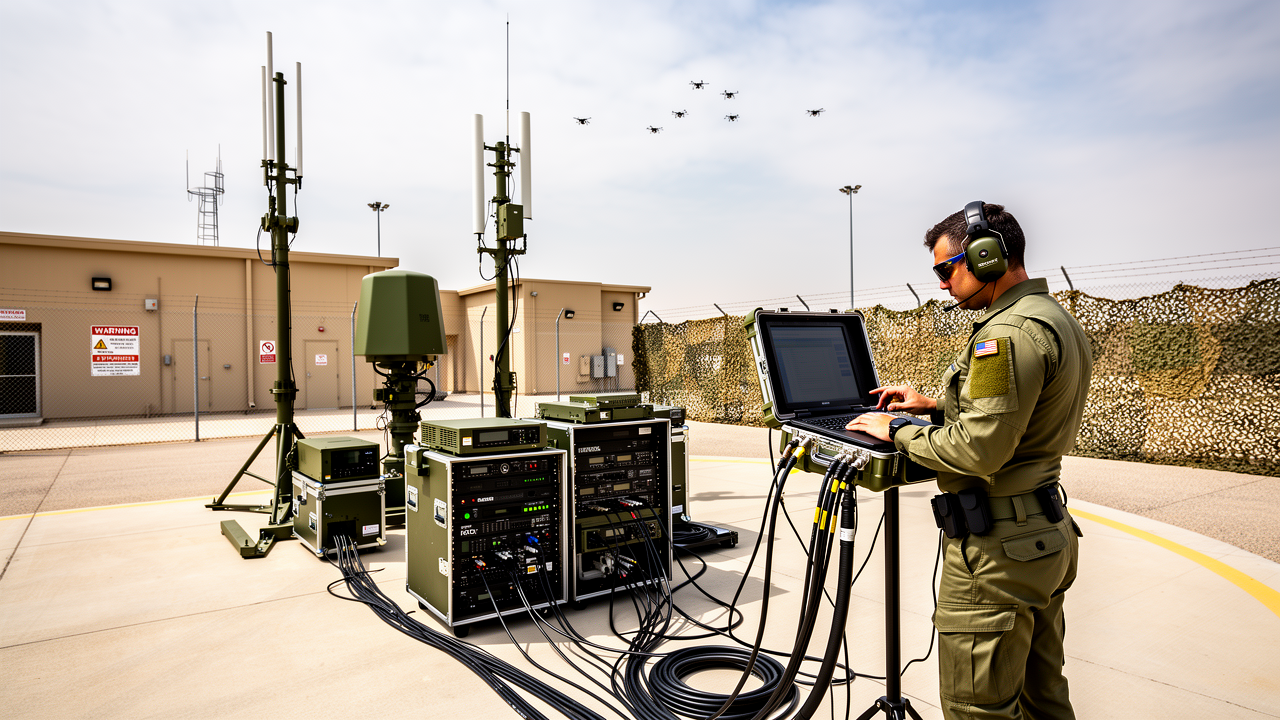
Countering Drone Threats: The Critical Role of Anti-UAV Signal Jamming and Wideband Solutions
Introduction
DroneShield recently secured an AUD 3.8 million contract with an unnamed Five Eyes government agency for the deployment of anti-drone systems. This news highlights the growing global demand for effective counter-UAV technology. With the proliferation of drone technology and the increasing risks of malicious use, governments and defense agencies worldwide are actively seeking advanced solutions to protect critical infrastructure and sensitive areas. This contract signifies a continuous increase in investment in comprehensive anti-UAV capabilities, where signal jamming technology holds a core position.
Industry Challenges & Pain Points
Currently, illegal or malicious drones pose serious threats to military bases, airports, critical infrastructure, and public safety. These drone technologies are rapidly evolving, featuring longer ranges, improved stealth, and diverse attack patterns. Traditional countermeasures, such as single-frequency or narrowband jamming, often struggle to effectively address these varied threats that may operate across a wide spectrum. Existing defense systems frequently lag behind drone technological advancements due to fixed frequencies and slow response times, leading to defensive vulnerabilities.
The Core Countermeasure: Why Signal Interference Sources Are Key
In counter-UAV operations, signal interference sources play a crucial role. By emitting specific radio frequency signals, they can effectively block communication links, navigation signals, or remote control commands between the drone and its operator, thereby forcing the drone to crash, return to base, or lose control. To effectively combat modern drones, signal interference sources must possess wideband coverage capabilities and excellent frequency agility. Wideband capability ensures coverage of all communication bands a drone might use, while frequency agility allows the system to quickly switch frequencies to adapt to evolving threat environments and avoid evasion.
Advanced Solution: 400M Instantaneous Bandwidth Signal Generator
To meet the demand for advanced anti-UAV signal jamming capabilities, we recommend the 400M Instantaneous Bandwidth Signal Generator. This device is specifically designed to tackle complex RF threats, with its core advantages being:
- Ultra-wide Frequency Coverage: Supports an extremely wide frequency range of 70-6000MHz, covering nearly all commercial and military drone communication bands.
- 400M Instantaneous Bandwidth: Possesses an instantaneous bandwidth capability of 400M, allowing simultaneous interference of multiple frequency bands or wideband frequency-hopping drones in a single operation, significantly enhancing jamming efficiency.
- Software-defined Frequency Modulation: Employs advanced software-defined frequency modulation technology, enabling users to flexibly adjust interference frequencies, modes, and power based on real-time threat situations, achieving precise and efficient countermeasures.
This generator is an ideal choice for building next-generation anti-UAV systems, providing powerful electronic warfare capabilities for defense and security departments.
Conclusion
As drone threats become increasingly severe, advanced counter-UAV technologies, especially wideband, software-defined signal interference solutions, have become an indispensable part of defense systems. The 400M Instantaneous Bandwidth Signal Generator, with its exceptional performance, provides a solid foundation for effectively addressing future drone challenges.
Contact us today to learn how the 400M Instantaneous Bandwidth Signal Generator can enhance your anti-UAV defense capabilities and obtain customized solutions.
FAQ
Question 1: How does the 400M Instantaneous Bandwidth Signal Generator address multi-band drone threats?
*Answer 1: This generator features an ultra-wide frequency range of 70-6000MHz and 400M instantaneous bandwidth, allowing it to simultaneously cover and interfere with multiple communication bands a drone might use within a single operational cycle, or effectively suppress wideband frequency-hopping signals.
Question 2: What are the advantages of software-defined frequency modulation?
*Answer 2: Software-defined frequency modulation allows users to flexibly and rapidly adjust interference frequencies, waveforms, and power without hardware changes. This enables the system to quickly adapt to new threat types or changing spectrum environments, offering extremely high tactical flexibility and future compatibility.
