

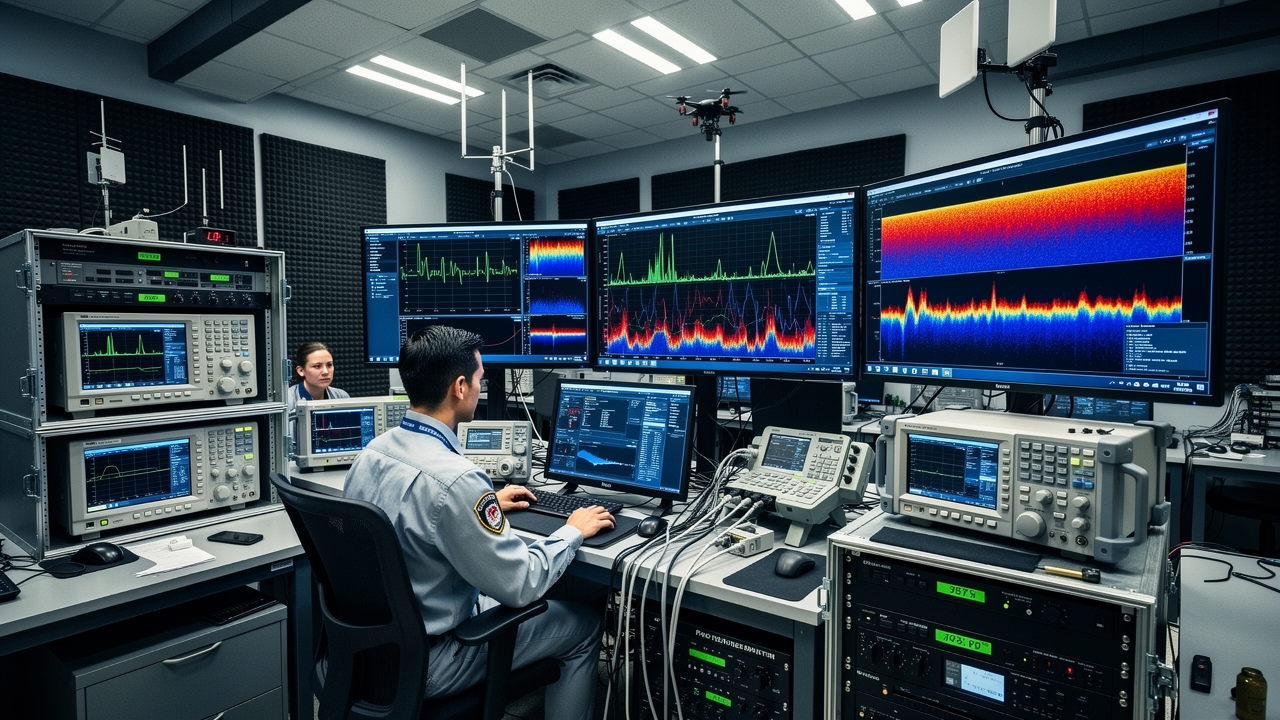
Mastering the Future: How the 400M Instantaneous Bandwidth Signal Generator Empowers Counter-UAV Operations
Introduction
Recently, the UK Defence Innovation Centre (UKDI) announced a significant 30 million pound investment aimed at accelerating drone technology development, with a particular focus on innovation in counter-unmanned aerial systems (C-UAS) and future uncrewed system capabilities. This initiative highlights the urgent global need to address the growing threat from drones and the pressing demand for advanced technological solutions in defense and security. As drones gain widespread application in both military and civilian sectors, the potential risks they pose are becoming increasingly prominent, driving nations to increase R&D investment to maintain leadership in this critical technological domain.
Industry Challenges & Pain Points
Currently, drone technology is advancing rapidly. Whether used for reconnaissance, surveillance, or potential attacks, unauthorized drones pose severe challenges to critical infrastructure, military bases, and public safety. Traditional defense methods, such as fixed-frequency jammers or radar systems, often struggle with slow response times, limited frequency ranges, and difficulty effectively countering new, multi-functional drone swarms. Especially when faced with wideband drone threats employing complex communication technologies like frequency hopping or spread spectrum, traditional systems prove inadequate, urgently requiring more adaptable and flexible countermeasure solutions.
The Core Countermeasure: Why Signal Interference Source is Key
In counter-UAV operations, an efficient signal interference source is central to successful countermeasures. It disrupts the communication link between a drone and its operator by emitting wideband or directional jamming signals, forcing the drone to lose control or land autonomously. For effective countermeasures, a signal interference source must possess the following critical characteristics: extremely wide frequency coverage, instantaneous bandwidth capability, and flexible frequency agility. These features enable it to quickly respond and adapt to evolving drone threat frequencies, ensuring powerful suppression capabilities even in complex electromagnetic environments.
Advanced Solution: 400M Instantaneous Bandwidth Signal Generator
Facing complex drone threats, the 400M Instantaneous Bandwidth Signal Generator offers an ideal solution. This device features an ultra-wide output frequency range of 70-6000MHz, capable of covering most drone communication frequencies from low to high bands. Its core advantages lie in its 400M instantaneous bandwidth capability and software tunable characteristics, allowing users to rapidly adjust jamming frequencies and modes via software according to the real-time threat environment. This means it can not only effectively address currently known drone frequency bands but also flexibly adapt to unknown or frequency-hopping threats that may emerge in the future, providing robust electromagnetic suppression assurance for counter-UAV systems.
Conclusion
The UKs substantial investment in drone technology signals an accelerated global defense strategy shift towards addressing drone threats. In this context, the 400M Instantaneous Bandwidth Signal Generator, with its wideband coverage, instantaneous bandwidth, and software tunable capabilities, is undoubtedly a critical core component for building future efficient and adaptive counter-UAV systems.
Call to action
To learn more about the 400M Instantaneous Bandwidth Signal Generator and its applications in counter-UAV operations, please visit our official website or contact our team of experts.
FAQ
Question 1: What is the role of instantaneous bandwidth in counter-UAV operations?
Answer 1: Instantaneous bandwidth refers to the frequency range a signal generator can process simultaneously. In counter-UAV operations, a wide instantaneous bandwidth allows the device to interfere with multiple frequencies or counter frequency-hopping signals simultaneously, significantly enhancing countermeasure efficiency and success rate.
Question 2: How does the 400M Instantaneous Bandwidth Signal Generator adapt to future drone threats?
Answer 2: The signal generator, through its ultra-wide 70-6000MHz frequency range and software tunable characteristics, can flexibly configure and upgrade jamming strategies. This software-defined capability allows it to quickly adapt to new drone communication protocols and frequencies, ensuring long-term effectiveness.
References
- Airforce Technology (https://www.airforce-technology.com/news/ukdi-drone-tech-investment/)
