

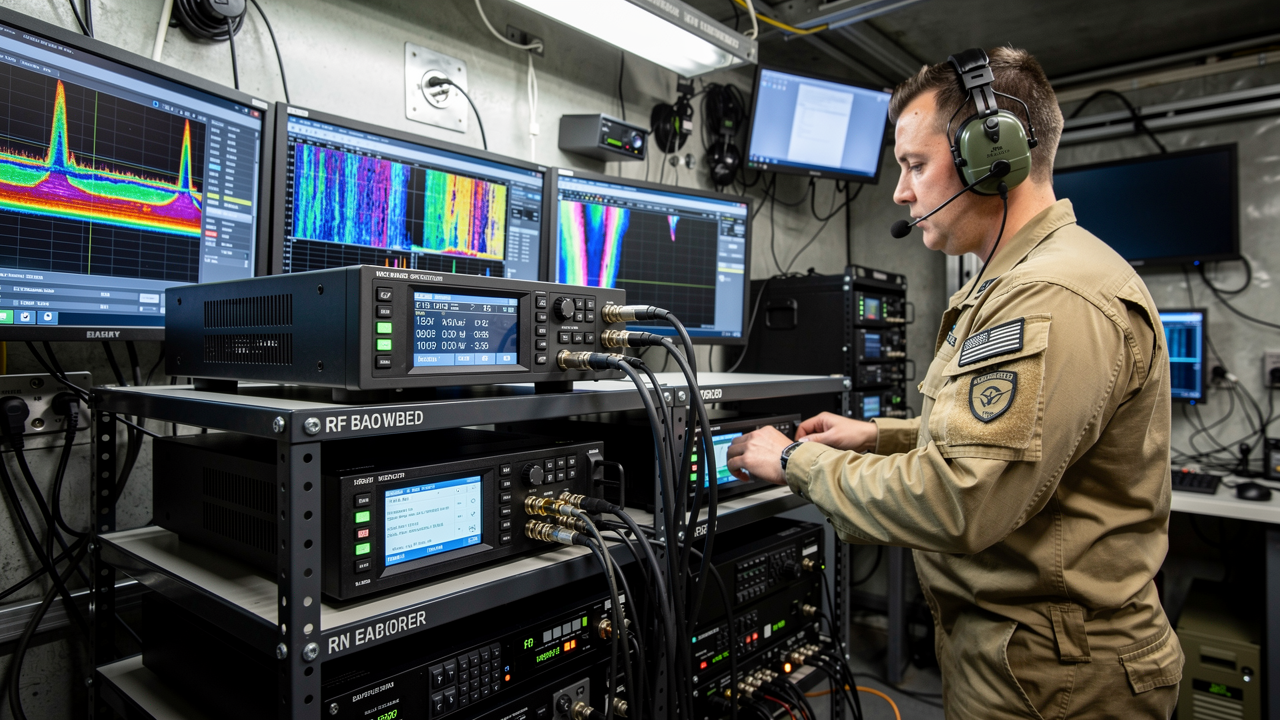
Lockheed Martin Counter-UAV Innovation and 400M Instantaneous Bandwidth Signal Generator: Key to Aerial Threat Response
Introduction
Recently, Lockheed Martin successfully demonstrated the first 90-degree vertical launch of the Joint Air-to-Ground Missile JAGM, a breakthrough aimed at enhancing Counter-Unmanned Aircraft Systems C-UAS capabilities. This demonstration highlights the urgency and innovative demands of modern military forces in responding to evolving drone threats, particularly in protecting fixed or mobile assets from drone swarm attacks. This marks a significant improvement in the ability to respond to rapid, diverse aerial threats on future battlefields.
Industry Challenges & Pain Points
Currently, unauthorized drones and increasingly sophisticated UAV technology pose serious challenges to global security. Small, fast, low-flying drone swarms are difficult for traditional radar systems to effectively detect, and their diverse communication links and growing autonomy make them harder to counter with single-frequency or narrow-band jamming methods. Traditional defense methods, such as fixed-frequency or limited-bandwidth jamming equipment, often struggle to cope with these wideband, frequency-hopping, and adaptive threats, leading to vulnerabilities in defence systems.
The Core Countermeasure: Why the Signal Interference Source is Key
In counter-UAV systems, the signal interference source is the core component for achieving effective countermeasures. Its role is to cut off communication between the UAV and its ground control station or interfere with its navigation system by emitting jamming signals, thereby causing it to lose control or crash. Faced with the multi-band, wide-bandwidth, and frequency-hopping characteristics of modern UAVs, countermeasure systems must possess an extremely wide RF coverage range, instantaneous wideband jamming capability, and high frequency adaptability. Only in this way can enemy UAV threats be effectively suppressed and neutralized.
Advanced Solution: 400M Instantaneous Bandwidth Signal Generator
To effectively address the challenges mentioned above, the 400M Instantaneous Bandwidth Signal Generator offers an ideal solution. This device features an ultra-wide frequency range of 70-6000MHz, ensuring comprehensive coverage of almost all known UAV communication bands. Its 400M instantaneous bandwidth capability enables the device to simultaneously jam multiple wideband signals or rapidly and effectively suppress frequency-hopping UAVs. More importantly, it supports software-defined frequency modulation, meaning operators can flexibly adjust jamming strategies and frequencies according to the real-time threat environment, thereby achieving precise strikes and efficient countermeasures against complex and diverse UAV threats. This flexibility and powerful performance make it a core component of new-generation counter-UAV electronic warfare systems.
Conclusion
Lockheed Martins innovation in counter-UAV technology and the development of wideband, software-defined signal generators together paint a blueprint for future air defense. The 400M Instantaneous Bandwidth Signal Generator, with its exceptional performance, provides critical technological support for addressing current and future drone threats.
Contact us today to learn how the 400M Instantaneous Bandwidth Signal Generator can empower your counter-UAV defense system and enhance your airspace security capabilities.
FAQ
Question 1: Why is instantaneous bandwidth so important in counter-UAV applications?
Answer 1: Instantaneous bandwidth refers to the frequency range that a signal generator can process or generate at the same time. In the counter-UAV field, drones may use frequency-hopping or wideband communication. High instantaneous bandwidth allows the jammer to cover these hopping frequencies or wideband channels simultaneously, thereby more effectively cutting off drone communication and improving countermeasure success rates.
Question 2: How does software-defined frequency modulation enhance anti-drone capabilities?
Answer 2: Software-defined frequency modulation SDFM allows users to quickly and flexibly change the frequency, bandwidth, and modulation type of a signal through software, without needing to replace hardware. This enables counter-UAV systems to adapt in real time to new drone threat spectrums, countering frequency-hopping and adaptive frequency selection drones, providing stronger battlefield adaptability and combat capability.
