

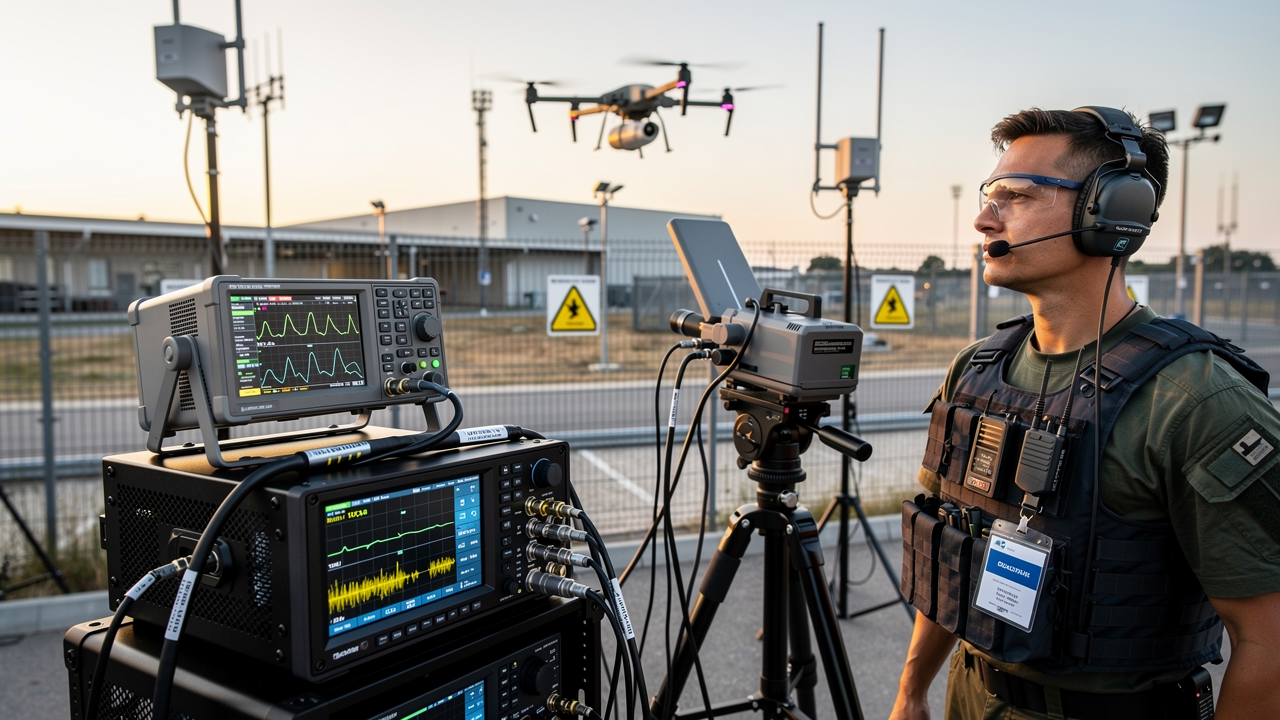
US DHS Establishes Drone Office: Deconstructing Counter-UAS Technology Core and 400M Instantaneous Bandwidth Signal Generator
Introduction
Recently, the US Department of Homeland Security DHS announced the establishment of a Drone Executive Office, aiming to unify drone operations management and counter-UAS technology. This initiative reflects growing global security concerns regarding drones. With the rapid development of drone technology and its widespread application in commercial, military, and civilian sectors, effectively addressing unauthorized or potentially threatening drones has become an urgent challenge for governments and security agencies worldwide. The establishment of the new DHS office signifies a strategic development and integration of counter-UAS technology, leading to a substantial increase in demand for related technologies and equipment.
Industry Challenges and Pain Points
Currently, the counter-UAS domain faces multiple challenges. First, unauthorized drone activities are increasingly frequent, ranging from smuggling and reconnaissance to potential terrorist attacks, posing diverse threat forms. Second, modern drone communication technology is continuously evolving, featuring stronger anti-jamming capabilities, such as employing frequency hopping, spread spectrum, and operating in non-traditional frequency bands. Traditional countermeasures often rely on fixed frequencies or narrowband jamming, struggling to effectively counter these wideband, frequency-agile threats. The lack of unified wideband coverage and rapid frequency adjustment capabilities renders existing systems inadequate in the face of rapidly changing and diverse drone threats.
The Core Countermeasure: Why Signal Interference Source is Key
In counter-UAS systems, the signal interference source is the critical core for achieving effective countermeasures. By emitting interference signals, it can sever the communication link between a drone and its remote controller, disrupt its GNSS navigation signals, or even directly affect its flight control system, forcing it to crash, return, or land. To achieve highly effective countermeasures, the interference source must possess the following characteristics:
- Wideband Coverage Capability: Able to cover all common communication and navigation frequency bands used by drones, such as 2.4GHz, 5.8GHz, and L-band GNSS.
- Instantaneous Bandwidth: Capable of providing instantaneous interference across a wide band, simultaneously suppressing multiple frequency points.
- Frequency Agility and Software Tunability: Able to quickly adjust interference frequencies and modes based on the threat type and target drone communication protocols.
- High Power Output: Ensures the interference signal can effectively suppress drone signals even at long distances.
These characteristics ensure that countermeasure systems can flexibly and efficiently respond to different types and technologies of drone threats.
Advanced Solution: 400M Instantaneous Bandwidth Signal Generator
Facing these challenges, the YAICS SG-6000-400 400M Instantaneous Bandwidth Signal Generator is an ideal solution. As a high-performance RF signal generation device, it is specifically designed for applications requiring wideband, high-precision signal output, making it particularly suitable as the core interference source for advanced counter-UAS systems.
Key Technical Specifications:
- Ultra-Wide Frequency Range: Supports continuous frequency output from 70MHz to 6000MHz, covering almost all common communication and navigation frequency bands used by drones, including ISM bands and GNSS bands.
- 400MHz Instantaneous Bandwidth: Features 400MHz instantaneous bandwidth capability, meaning it can simultaneously generate, modulate, and output signals across this wide bandwidth, significantly enhancing jamming effectiveness against multi-band or wideband frequency-hopping drones.
- Software Defined Frequency Modulation: Utilizes a Software Defined Radio SDR architecture, supporting various modulation modes such as CW, AM, FM, PM, BPSK, QPSK, 16QAM, 64QAM, and allowing for rapid, flexible frequency and mode adjustments via software. Its frequency tuning time is only 200μs, ensuring extremely fast response.
- Adjustable Output Power: Output power ranges from -10dBm to 10dBm, allowing for precise adjustment according to actual countermeasure needs.
- Compact and Portable: Dimensions of 250mm x 150mm x 50mm and a weight of just 2kg, facilitating integration into mobile or fixed countermeasure platforms.
These features of the YAICS SG-6000-400 enable it to effectively address complex drone threats, providing versatile, programmable, and efficient countermeasure capabilities, making it an indispensable key component for building next-generation counter-UAS systems.
Conclusion
The establishment of the Drone Executive Office by the US Department of Homeland Security will undoubtedly accelerate the development of counter-UAS technology. Faced with increasingly severe drone threats, wideband, instantaneous bandwidth, and software-tunable signal interference sources become central to building effective countermeasure systems. The YAICS SG-6000-400 400M Instantaneous Bandwidth Signal Generator, with its ultra-wide frequency range of 70-6000MHz, 400MHz instantaneous bandwidth, and software-defined frequency modulation capabilities, provides a powerful and flexible hardware foundation for next-generation counter-UAS solutions.
Learn More Now
Discover how the YAICS SG-6000-400 400M Instantaneous Bandwidth Signal Generator can enhance your counter-UAS system performance. Visit our official website for detailed product information and technical support.
FAQ
Question 1: What are the main counter-UAS scenarios for the 400M Instantaneous Bandwidth Signal Generator?
Answer 1: It is suitable for scenarios requiring fast, wideband jamming, such as security for critical infrastructure, border patrol, large event area protection, and mobile countermeasure platforms. Its wide frequency coverage and instantaneous bandwidth capability effectively address multiple types of drone threats.
Question 2: What are the advantages of the Software Defined Frequency Modulation SDR function?
Answer 2: The SDR function allows users to quickly configure and adjust frequencies, modulation modes, and jamming strategies via software, without needing hardware replacement. This enables the system to flexibly adapt to new drone communication protocols and anti-jamming technologies, greatly enhancing system adaptability and future upgradeability.
