

New Trends in Counter-UAV Systems: How Wideband Signal Generators Address Complex Airspace Threats
Introduction
Recently, the UK government issued a new call for C-UAS equipment evaluations, aiming to find innovative and effective technical solutions to address the growing drone threat. This initiative highlights the high level of concern among nations regarding illegal drone activities and indicates the challenges faced by existing countermeasures. As drone technology rapidly advances, its application scenarios and potential risks continue to expand, from civilian safety hazards to national security threats, necessitating more advanced and flexible defense systems.
Industry Challenges & Pain Points
Currently, illegal drone activities are increasingly frequent, and their technical complexity is continuously rising. Traditional counter-UAV systems often rely on preset narrow-band interference frequencies, proving inadequate when facing drones equipped with advanced communication capabilities such as frequency hopping and spread spectrum. These drones can rapidly switch operating frequencies, making it difficult for traditional fixed-frequency jammers to effectively lock onto and suppress them. Furthermore, scenarios involving multiple types of drones invading simultaneously demand higher spectral coverage capabilities from systems, where single-frequency countermeasures struggle to address multi-target, multi-band threats.
The Core Countermeasure: Why Signal Interference Source is Key
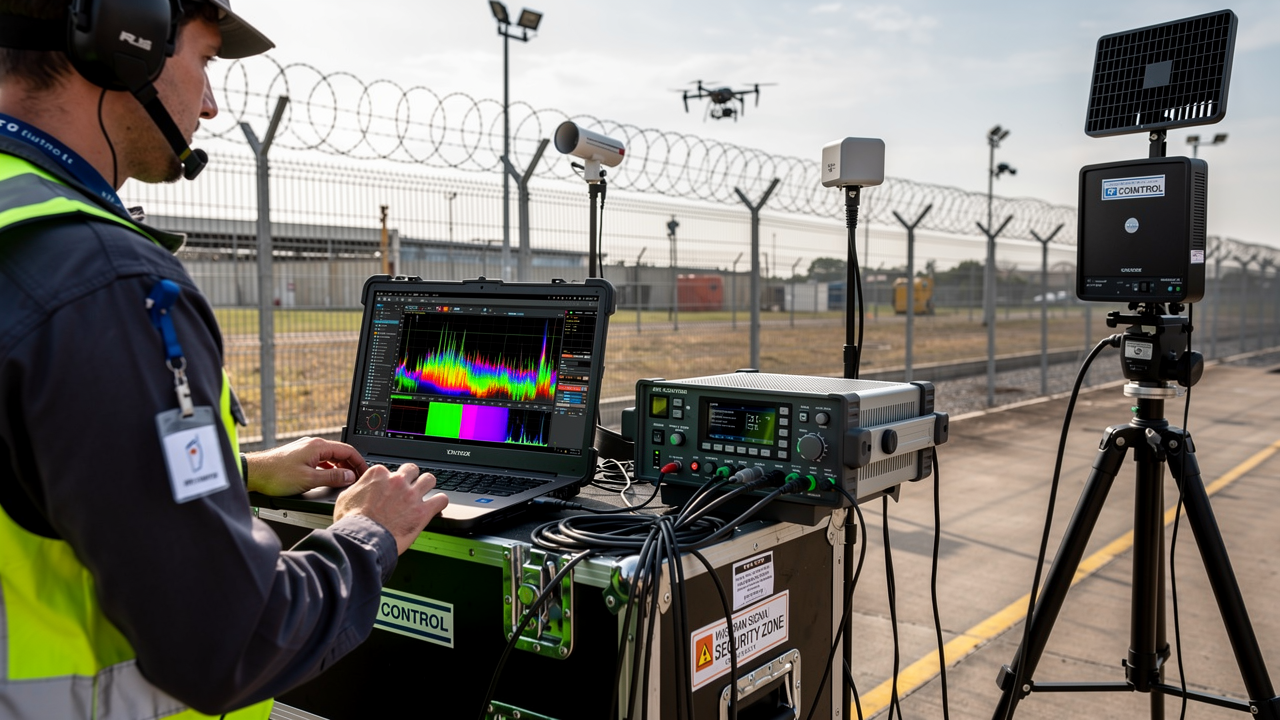
In counter-UAV operations, the signal interference source is the core component for achieving effective defense. Its role is to emit electromagnetic waves at specific frequencies, interrupting the communication link between the drone and its remote controller, or interfering with its GPS navigation signals, thereby causing it to lose control, land forcefully, or return to base. To effectively counter modern drone technology, interference sources must possess wideband coverage and frequency agility. Wideband capability means being able to cover all potential communication bands that drones might use, while frequency agility ensures rapid response even when drones employ frequency hopping, maintaining continuous interference.
Advanced Solution: 400M Instantaneous Bandwidth Signal Generator
Facing complex drone threats, a signal generator with outstanding performance is crucial. Our company’s 400M Instantaneous Bandwidth Signal Generator is a cutting-edge product designed for precisely these needs. It features an ultra-wide frequency range of 70-6000MHz, capable of covering most known and potentially emerging drone communication bands. Its core advantage lies in providing up to 400MHz of instantaneous bandwidth, meaning it can perform efficient interference simultaneously across a wide frequency band, rather than just narrow-band spot frequency interference. More importantly, this device supports software-defined frequency modulation, allowing operators to flexibly adjust interference frequencies and strategies via software based on real-time battlefield situations and threat types, thereby achieving rapid and precise responses to various complex drone threats.
Conclusion
The UK government call for counter-UAV equipment evaluations once again emphasizes the urgent global need to enhance C-UAS capabilities. To address evolving drone threats, wideband, software-tunable signal interference solutions are key. The 400M Instantaneous Bandwidth Signal Generator, with its wide frequency range, large instantaneous bandwidth, and flexible software-defined capabilities, provides powerful and reliable core support for modern counter-UAV systems.
Contact us today to learn how the 400M Instantaneous Bandwidth Signal Generator can enhance your counter-drone defense capabilities.
FAQ
Question 1: What are the main advantages of wideband signal generators in counter-UAV systems?
Answer 1: Wideband signal generators can cover a broader frequency range and provide greater instantaneous bandwidth, enabling them to effectively interfere with drones featuring advanced communication capabilities such as frequency hopping and spread spectrum, addressing multi-band and multi-target threats.
Question 2: How does the 400M Instantaneous Bandwidth Signal Generator achieve rapid response to complex drone threats?
Answer 2: This signal generator supports software-defined frequency modulation. Operators can flexibly and quickly adjust interference frequencies and strategies via software to adapt to real-time changing drone threat types and battlefield environments.
