

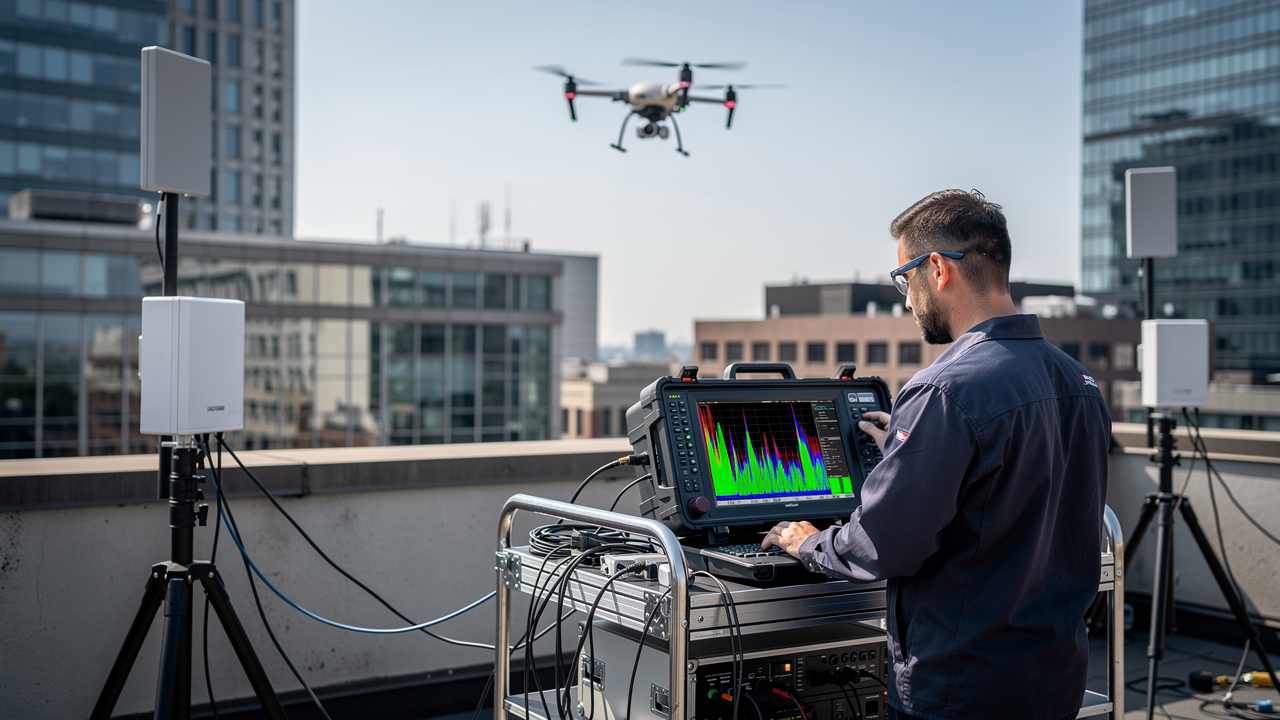
New Trends in European Counter-UAS Systems: How the 400M Instantaneous Bandwidth Signal Generator Addresses Threats
Introduction
Recently, Intelic and DroneShield announced a partnership to jointly develop modular European C-UAS capabilities. This collaboration signifies Europe’s urgent need for enhanced counter-drone solutions in the current geopolitical context. With the proliferation of drone technology and its growing strategic role in various conflicts, national defense agencies are actively seeking more flexible and efficient countermeasures to address increasingly complex airborne threats. This move highlights the industry’s emphasis on integrated, adaptable, next-generation counter-UAS systems.
Industry Pain Points and Challenges
Currently, unauthorized drone activities pose serious threats to military installations, critical infrastructure, and even civilian airspace. These drones vary widely, from small consumer-grade UAVs to more complex military models, differing in flight altitude, speed, and communication methods, with rapid technological iteration. Traditional counter-UAS systems often rely on fixed frequency or limited bandwidth jamming methods, making it difficult to effectively counter these diverse threats. For example, once a drone switches communication frequencies or employs frequency hopping technology, traditional systems become ineffective. Furthermore, insufficient capability for rapid deployment and response to new threats also presents severe challenges to existing defense systems.
Core Countermeasure: Why Signal Interference is Key
In counter-UAS strategies, the signal interference source plays a core role. It achieves forced landing, return to base, or deviation from the planned route by emitting specific radio frequency signals that disrupt the communication link between the drone and its operator, or interfere with its GNSS navigation system. To effectively counter diverse drone threats, the interference source must possess wide instantaneous bandwidth and excellent frequency agility. Wide bandwidth ensures coverage of various communication and navigation frequency bands a drone might use, while frequency agility allows the system to quickly adjust jamming frequencies to counter potential frequency switching or hopping strategies employed by drones, thereby maintaining continuous suppression.
Solution: 400M Instantaneous Bandwidth Signal Generator
To address the challenges mentioned above, the 400M Instantaneous Bandwidth Signal Generator emerges as an ideal choice for counter-UAS systems. This product offers an ultra-wide frequency range of 70-6000MHz, ensuring coverage of almost all known and potential drone communication and navigation frequency bands. Its core advantage lies in its 400MHz instantaneous bandwidth, enabling the system to effectively jam a large range of frequencies simultaneously, significantly enhancing its counter-capability against wideband frequency-hopping drones. More importantly, this signal generator features software-tunable capability, allowing users to define or rapidly adjust output frequencies and modulation modes via software, thereby flexibly adapting to ever-changing threat environments and mission requirements. This not only enhances the flexibility of counter-UAS operations but also reduces the cost of system upgrades and maintenance.
Conclusion
The collaboration between Intelic and DroneShield and Europe’s exploration of modular C-UAS capabilities clearly point to the future direction of counter-UAS system development: highly integrated, flexibly adaptable, and equipped with wideband high-efficiency jamming capabilities. The 400M Instantaneous Bandwidth Signal Generator, with its outstanding frequency coverage, instantaneous bandwidth, and software-tunable features, provides core support for building next-generation intelligent counter-UAS systems. It not only addresses current industry pain points but also offers a forward-looking solution for future complex and dynamic airborne threats.
Contact us now to learn more about the detailed technical specifications of the 400M Instantaneous Bandwidth Signal Generator or to discuss how it can be integrated into your counter-UAS defense system.
FAQ
Question 1: What are the core challenges in anti-UAV systems?
Answer 1: The main challenges lie in the rapid development of UAV technology, diverse threat patterns, and the limitations of traditional fixed-frequency jamming. Future anti-UAV systems must have broader coverage and more flexible response capabilities.
Question 2: What are the unique advantages of the 400M Instantaneous Bandwidth Signal Generator?
Answer 2: It offers wide frequency coverage from 70-6000MHz, 400MHz instantaneous bandwidth, and software-tunable capability, allowing flexible adaptation to complex and changing jamming requirements. This makes it excel in countering multi-band, frequency-hopping drones.
