

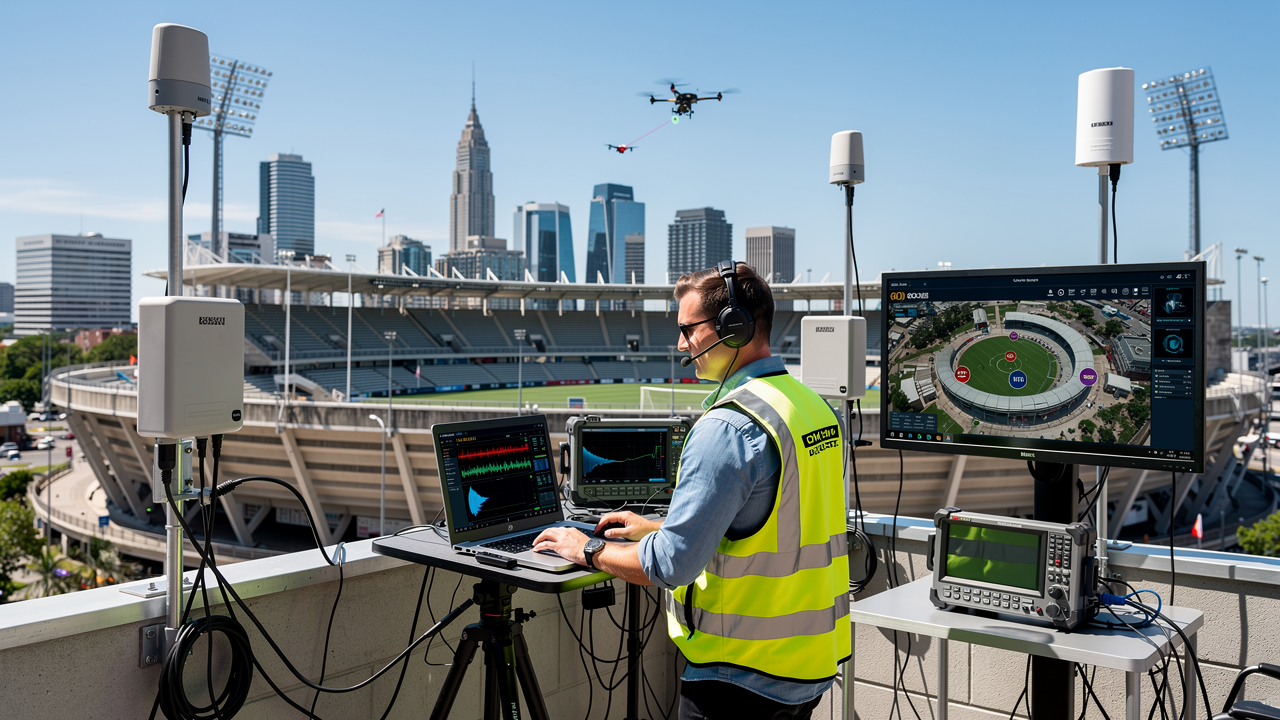
Securing Skies: How the 400M Instantaneous Bandwidth Signal Generator Strengthens World Cup Counter-UAV Security
Introduction
Recent news reports indicate that governments are taking action to ensure airspace security during World Cup events, addressing threats from unauthorized drones. This initiative highlights the urgent need to protect critical infrastructure and crowds at large public gatherings. With the rapid advancement of drone technology, the potential for misuse is growing, from illegal reconnaissance to malicious attacks, posing severe challenges to existing security systems.
Industry Challenges & Pain Points
Currently, drone technology is advancing rapidly, and its low-altitude, high-speed, and covert characteristics make it a potential threat in public safety. Traditional counter-UAV methods often rely on fixed frequencies or narrow-band jamming, which struggle against advanced drones with frequency-hopping, spread-spectrum, and multi-target cooperative capabilities. These systems find it difficult to effectively detect and suppress wideband, frequency-hopping drones, leading to blind spots in defense systems and an inability to form a comprehensive and reliable counter-UAV wideband signal jamming capability.
The Core Countermeasure: Why Signal Interference is Key
In building an efficient counter-UAV defense system, the signal interference source plays a crucial role. A powerful signal interference source can effectively block the communication link between a drone and its operator, forcing it to return, land, or lose control. To achieve this, the interference source must possess a wide frequency coverage range, instantaneous bandwidth capability, and rapid frequency tuning ability. This is vital for addressing constantly evolving drone communication protocols and evasion strategies, especially for counter-UAV wideband signal jamming.
Advanced Solution: 400M Instantaneous Bandwidth Signal Generator
For this purpose, we recommend the 400M Instantaneous Bandwidth Signal Generator as an ideal counter-UAV solution. This high-performance device features an ultra-wide frequency range of 70-6000MHz, capable of covering almost all mainstream drone communication and navigation frequency bands. Its core advantage lies in providing up to 400MHz of instantaneous bandwidth, allowing for interference across a wide range of frequencies in a very short time, effectively suppressing frequency-hopping and spread-spectrum drones. More importantly, it employs software-defined frequency modulation technology, enabling flexible and rapid frequency configuration and interference pattern adjustment based on threat types and environmental changes, providing unprecedented flexibility and efficiency for counter-UAV wideband signal jamming.
Conclusion
Facing increasingly complex drone threats, security for large events like the World Cup requires more advanced and flexible solutions. The 400M Instantaneous Bandwidth Signal Generator, with its unique advantages of wideband coverage, instantaneous bandwidth, and software tunability, provides critical technical support for building a robust counter-UAV wideband signal jamming system, ensuring absolute security of the event airspace.
Call to Action
Learn more about the 400M Instantaneous Bandwidth Signal Generator. Contact our expert team today for customized security solutions.
FAQ
Question 1: What is the significance of instantaneous bandwidth for counter-UAV systems?
Answer 1: Instantaneous bandwidth allows a system to effectively jam a wider range of frequencies simultaneously. This is crucial for countering drones that use complex communication technologies such as frequency hopping and spread spectrum, enabling more efficient disruption of their links.
Question 2: How does software-defined frequency modulation technology enhance the adaptability of counter-UAV systems?
Answer 2: Software-defined frequency modulation enables the system to rapidly and flexibly adjust interference frequencies and patterns based on real-time threat intelligence and environmental changes, without hardware modifications. This greatly improves the system’s response speed and adaptability to new drone threats.
