

Addressing Drone Challenges: How a 400M Instantaneous Bandwidth Signal Generator Strengthens Counter-Drone Capabilities
Introduction
Recently, the US Department of Homeland Security DHS announced the establishment of a specialized office aimed at addressing the growing threats from drones and counter-drone technologies. This move highlights the global concern regarding unauthorized drone activities. These drones may be used for surveillance, smuggling, or even attacks, posing significant risks to national security and critical infrastructure. DHS actions signify that various parties are actively seeking more effective strategies and tools to respond to rapidly evolving aerial threats.
Industry Challenges & Pain Points
Currently, drone technology is developing rapidly, with increasingly complex application scenarios and threat patterns. From reconnaissance equipment modified from small commercial drones to large systems with swarm attack potential, all pose severe challenges to traditional security defense systems. Traditional countermeasures often rely on fixed frequencies or narrow-band jamming, making it difficult to effectively counter drone communication protocols with frequency hopping, spread spectrum, and multi-band operation characteristics. These limitations often leave security departments powerless when facing fast-moving, stealthy, and potentially coordinated multi-target drone threats. How to achieve rapid, precise, and effective suppression of wideband, multi-mode drones has become an urgent need in the defense and security sectors.
The Core Countermeasure: Why Signal Interference Source is Key
Among numerous counter-drone strategies, the role of a signal interference source is pivotal. It disrupts the communication link between a drone and its operator by emitting interference signals, forcing the drone to lose control, return to base, or land. To achieve effective countermeasures, it is crucial for the interference source to possess wideband coverage capability and frequency adaptability. Facing increasingly complex drone communication systems and ever-changing frequency usage strategies, the interference source needs to achieve instantaneous and powerful signal suppression across a broad frequency range to ensure countermeasure effectiveness.
Advanced Solution: 400M Instantaneous Bandwidth Signal Generator (Product Specs)
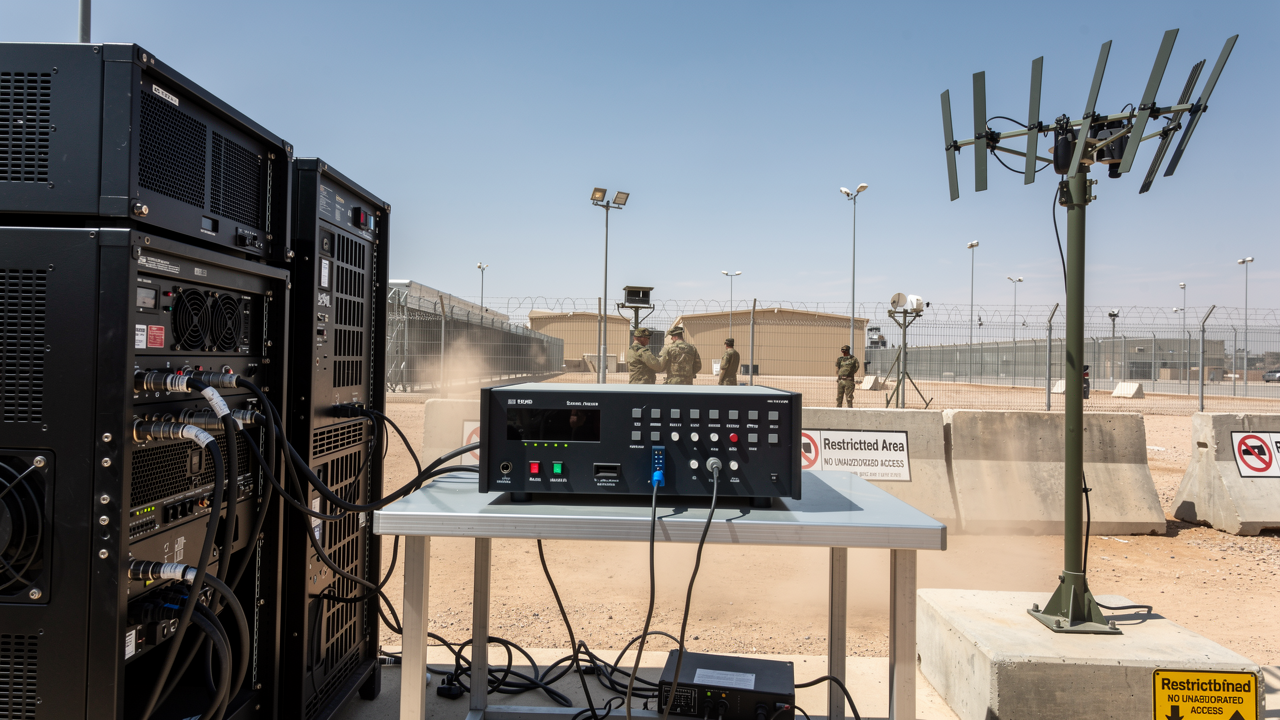
To meet the demands of modern counter-drone operations, the 400M Instantaneous Bandwidth Signal Generator offers an ideal solution. This device boasts a wide frequency coverage range of 70-6000MHz, capable of comprehensively covering common communication bands used by various drones. Its core advantage lies in its 400M instantaneous bandwidth, meaning it can generate and interfere with a 400MHz wide signal in an extremely short time, thereby effectively suppressing multiple drone channels or frequency-hopping signals. Furthermore, this signal generator supports software-tunable frequency modulation, allowing users to quickly adjust output frequencies and modulation parameters via software according to real-time threats and operational needs, greatly enhancing system flexibility and adaptability. It is a core component for future counter-drone systems.
Conclusion
As drone threats continue to escalate, the demand for advanced countermeasure technologies becomes increasingly urgent. The 400M Instantaneous Bandwidth Signal Generator, with its outstanding wideband capabilities, broad frequency coverage, and software-tunable features, provides strong support for tackling complex drone challenges. It represents the direction of next-generation counter-drone jamming technology, significantly enhancing the situational awareness and practical operational capabilities of defense and security departments.
Learn more about how the 400M Instantaneous Bandwidth Signal Generator can transform your counter-drone strategy. Contact our expert team today.
FAQ
Question 1: What are the primary application scenarios for the 400M Instantaneous Bandwidth Signal Generator?
Answer 1: It is primarily applied in counter-drone operations, radio reconnaissance, electronic warfare training, and other defense and security fields requiring wideband signal generation and interference.
Question 2: What advantages does the software-tunable frequency modulation function offer?
Answer 2: The software-tunable frequency modulation function enables the device to quickly adjust operating frequencies and modulation methods based on real-time environments and threat types, enhancing system flexibility, adaptability, and responsiveness to unknown threats.
