

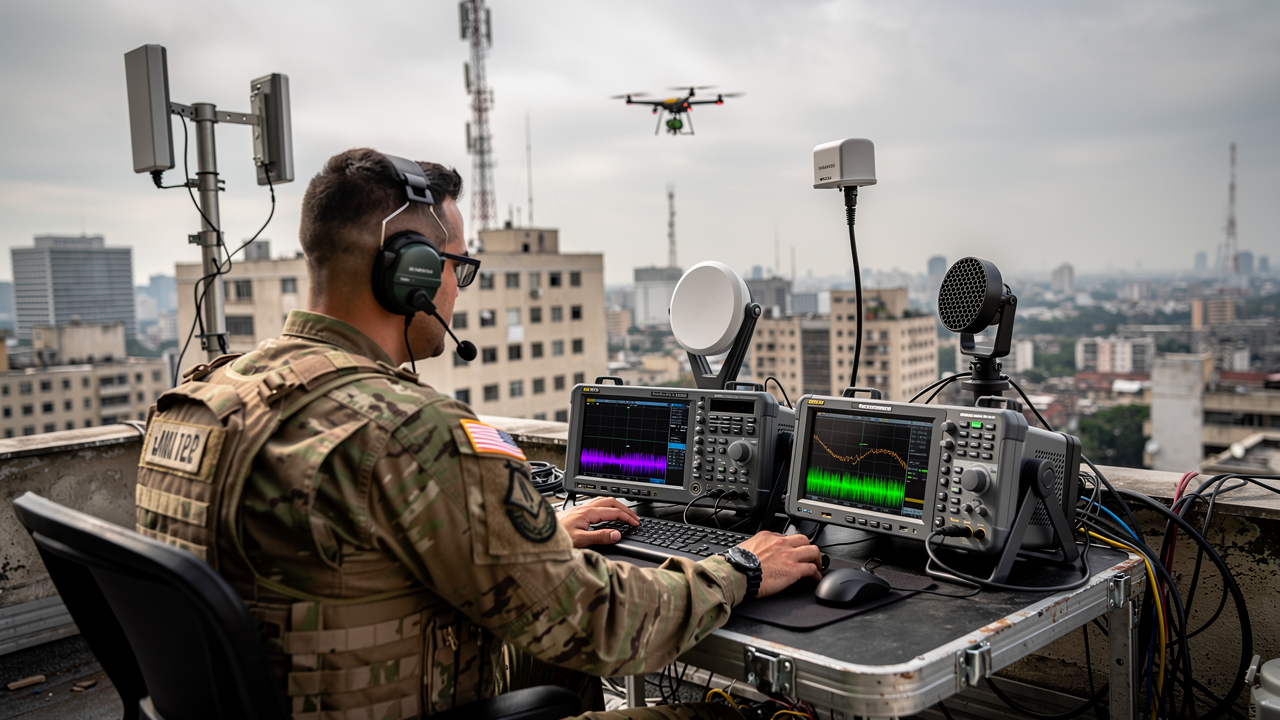
Addressing Drone Threats: The Critical Role of the 400M Instantaneous Bandwidth Signal Generator in Counter-UAS Jamming
Introduction
Recently, the US Department of Homeland Security DHS Drone Office received increased funding for counter-UAS systems. This move highlights growing global concern over unauthorized drones. As drone technology rapidly advances, it brings not only convenience but also unprecedented challenges to national security, critical infrastructure protection, and public safety. Faced with these rapidly evolving threats, enhancing effective countermeasure capabilities has become an urgent priority.
Industry Challenges & Pain Points
Currently, illegal drones are used for reconnaissance, smuggling contraband, and even potential malicious attacks. Their threat forms are diverse and unpredictable. However, traditional counter-UAS systems often have limitations: they typically rely on narrow bandwidths and fixed frequencies, making it difficult to effectively counter the multi-band, frequency-hopping communication technologies commonly used by modern drones. This slow response time and lack of flexibility mean traditional methods struggle to adapt to rapidly changing threat environments.
The Core Countermeasure: Why Signal Interference Sources Are Key
When building a robust counter-UAS system, the signal interference source is its core component. An efficient signal interference source must possess wideband coverage, instantaneous bandwidth, and frequency agility. These characteristics ensure that the system can simultaneously suppress multiple drone communication and navigation links, causing them to lose control, location, or deviate from their intended course. Only in this way can effective countermeasures against various drone threats be achieved.
Solution: 400M Instantaneous Bandwidth Signal Generator
To address the challenges mentioned above, we proudly introduce the 400M Instantaneous Bandwidth Signal Generator. This device is specifically designed to combat complex and dynamic drone threats, making it an ideal choice for the counter-UAS jamming domain with its outstanding performance parameters:
- Wide Frequency Coverage: A broad frequency range of 70-6000MHz, capable of comprehensively covering most common control, video transmission, and navigation links used by drones currently on the market.
- Instantaneous Bandwidth: An instantaneous bandwidth of 400M allows for simultaneous interference of wideband or frequency-hopping signals, effectively countering the complex communication patterns of advanced drones.
- Software Tunable: Utilizing software-defined technology for flexible and rapid frequency adjustment and jamming strategy switching, ensuring the system can dynamically optimize countermeasure effectiveness based on real-time threats.
This signal generator not only provides powerful jamming capabilities but also meets the stringent requirements of modern counter-UAS operations with its flexibility and adaptability.
Conclusion
The 400M Instantaneous Bandwidth Signal Generator offers an advanced and powerful tool for addressing the increasingly severe threat of drones. Its 70-6000MHz wide frequency coverage, 400M instantaneous bandwidth, and software-tunable features make it a critical component for protecting vital areas and ensuring national security. By deploying such cutting-edge equipment, we can more effectively respond to the challenges posed by future drone technology.
Learn more about our 400M Instantaneous Bandwidth Signal Generator today to enhance your counter-UAS defense capabilities.
FAQ
Question 1: How does the 400M Instantaneous Bandwidth Signal Generator improve counter-UAS effectiveness?
*Answer 1: Its wide frequency coverage of 70-6000MHz and 400M instantaneous bandwidth effectively interfere with various drone communication and navigation signals. Combined with software tunability, the device flexibly adapts to and counters complex and evolving drone threat environments.
Question 2: Does this device support multiple jamming modes?
*Answer 2: As a software-defined signal generator, it can be flexibly configured via software to generate various jamming waveforms and modes, adapting to different countermeasure requirements and the characteristics of target drones.
