

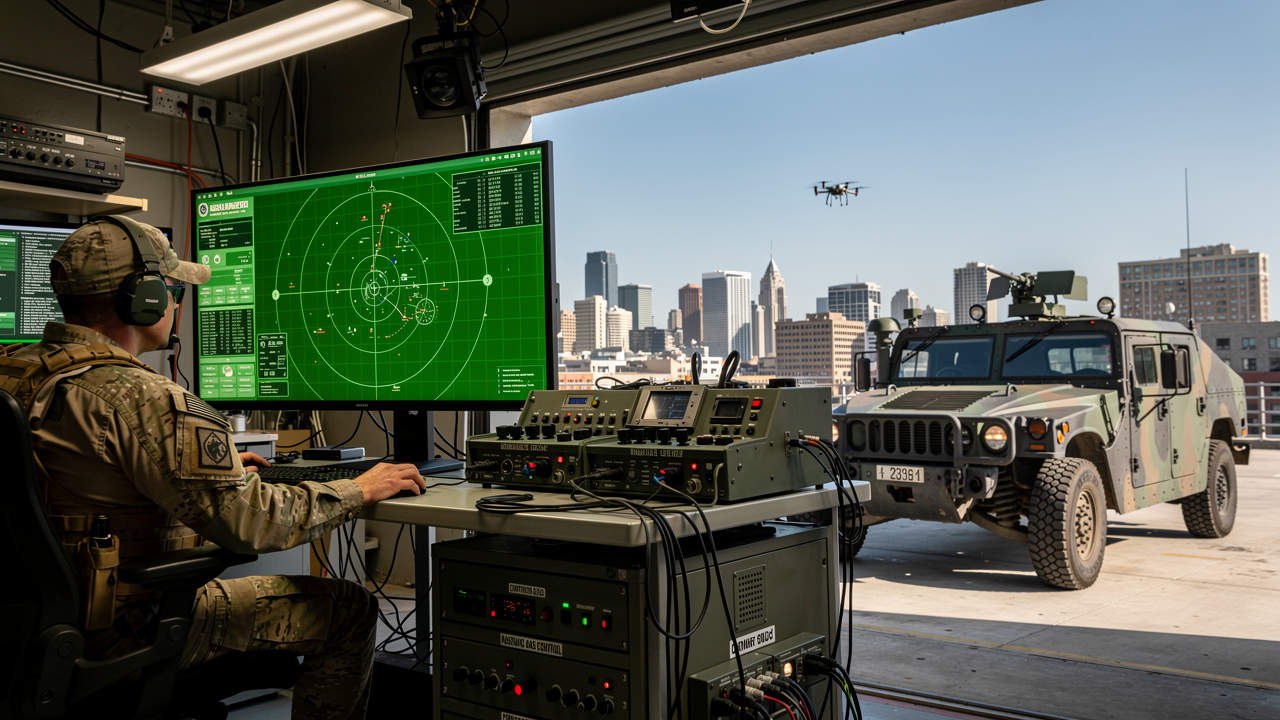
India Counter-UAS Procurement: A Strategic Outlook on Wideband Signal Jamming Technology
Introduction
India recent procurement of counter-unmanned aerial system C-UAS from Zen Technologies once again underscores the global urgency to address unauthorized drone threats. As drone technology matures and becomes widespread, its applications in reconnaissance, illicit transportation, and even potential attacks are concerning. Governments and critical infrastructure operators worldwide are actively seeking highly effective countermeasure solutions to protect national security and public order. This procurement not only reflects India defense modernization but also signals a continued heating up of the global counter-drone market and a growing demand for advanced technologies.
Industry Challenges & Pain Points
Currently, unauthorized drone activities pose an increasingly severe threat to military bases, airports, nuclear facilities, and critical infrastructure. Traditional air defense methods often struggle to effectively identify and counter small, low-altitude, high-speed drones with complex flight patterns. Furthermore, modern drones increasingly employ anti-jamming communication technologies such as frequency hopping and spread spectrum, significantly reducing the effectiveness of traditional fixed-frequency jamming equipment. The challenge for the industry is to build a comprehensive counter-drone system capable of rapid response, covering a wide frequency band, and possessing intelligent jamming capabilities.
The Core Countermeasure: Why Signal Interference Source is Key
Among various counter-drone strategies, signal interference is undoubtedly one of the most direct and effective methods. By emitting powerful radio frequency signals, it interferes with the communication link, navigation system, or telemetry data between the drone and its operator, causing it to lose control, land forcefully, or deviate from its intended flight path. To achieve efficient interference, the performance of the signal interference source is central. An ideal signal interference source must possess wideband coverage capabilities to deal with drone communications across different frequency bands. Simultaneously, its instantaneous bandwidth must be large enough to effectively suppress frequency hopping and wideband communication signals. More importantly, it needs frequency agility and software-defined flexibility to adapt to evolving drone threat patterns.
Advanced Solution: 400M Instantaneous Bandwidth Signal Generator
To meet the stringent counter-drone requirements, our company 400M Instantaneous Bandwidth Signal Generator offers an excellent solution. This device features an astonishingly wide frequency range of 70-6000MHz, ensuring coverage of most commercial and military drone communication bands. Its 400M instantaneous bandwidth capability allows it to interfere with multiple wideband or frequency-hopping signals simultaneously, significantly enhancing countermeasure efficiency. Crucially, the device supports software tunable frequency modulation, enabling users to quickly and flexibly adjust jamming frequencies and modes based on real-time threat scenarios, achieving precise targeting. These characteristics make it an indispensable core component for building advanced counter-drone systems.
Conclusion
India procurement of counter-UAS systems highlights the urgent global demand for advanced C-UAS technologies. To address future drone threats, wideband, high instantaneous bandwidth, and software-defined signal jamming technology are crucial. Our 400M Instantaneous Bandwidth Signal Generator is designed precisely for this purpose, providing a powerful and flexible solution for global defense and security sectors.
Contact us today to learn how the 400M Instantaneous Bandwidth Signal Generator can enhance your counter-drone capabilities.
FAQ
Question 1: What unique advantages does the 400M Instantaneous Bandwidth Signal Generator offer in counter-drone applications?
Answer 1: Its ultra-wide frequency coverage of 70-6000MHz, 400M instantaneous bandwidth, and software tunable frequency modulation enable it to effectively address various complex drone threats, providing efficient and flexible jamming capabilities.
Question 2: Why do counter-UAS systems require wideband and high instantaneous bandwidth jamming capabilities?
Answer 2: Modern drone communications commonly employ frequency hopping and spread spectrum technologies. Wideband and high instantaneous bandwidth ensure that jamming signals effectively cover these bands, thereby successfully suppressing drone communications and rendering them ineffective.
