

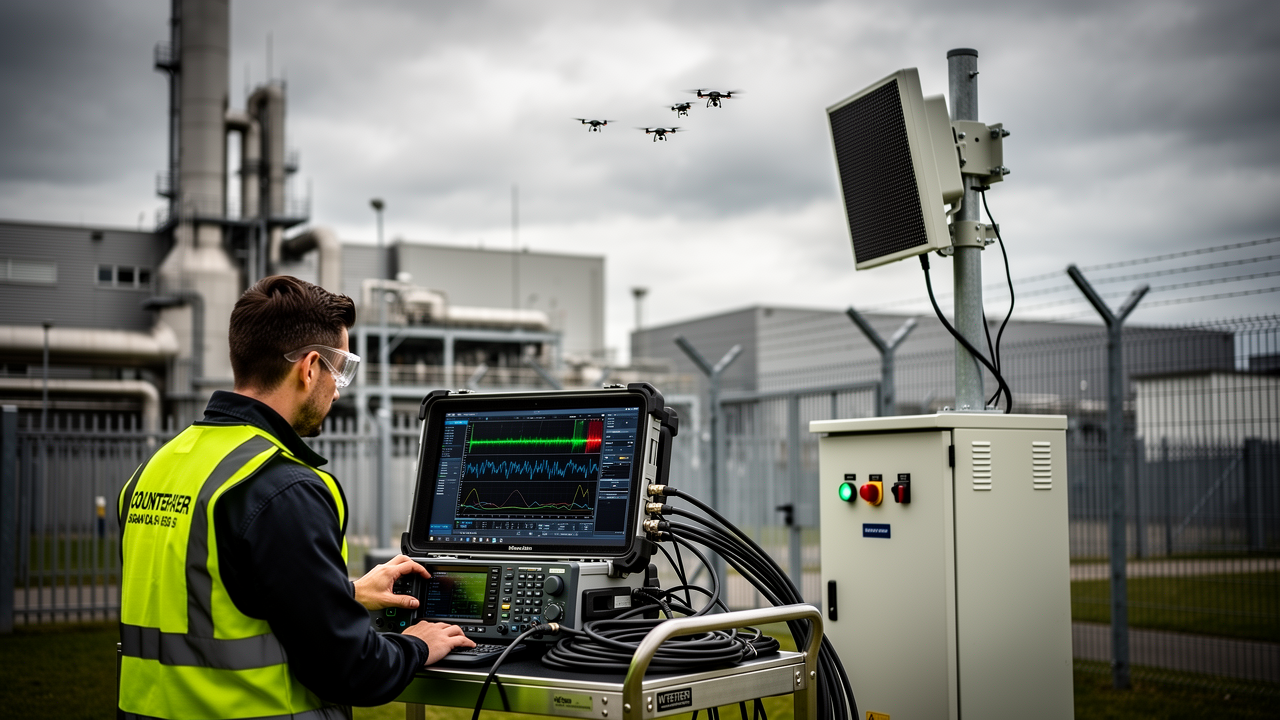
Countering Drone Threats: How a 400M Instantaneous Bandwidth Signal Generator Empowers Counter-UAV Systems
Introduction
Recently, Embraer has actively promoted its A-29 Super Tucano aircraft for counter-drone missions. This development indicates a growing global concern about drone threats, with defense and security agencies worldwide actively seeking diverse counter-UAV solutions. As drone technology, particularly small and medium-sized UAVs, becomes widely adopted in military and civilian domains, their potential for misuse also rises. From intelligence gathering to malicious attacks, drones have become a significant challenge for modern battlefields and critical infrastructure protection. Therefore, developing efficient and flexible counter-UAV systems is urgently needed.
Industry Challenges and Pain Points
Currently, unauthorized drone activities pose increasingly severe threats. These drones, ranging from simple consumer-grade devices to complex military platforms, are capable of reconnaissance, target designation, and even carrying small payloads for attacks. Traditional countermeasure methods often face limitations, such as:
- Frequency Rigidity: Many traditional jamming devices operate at fixed frequencies or within narrow bands, struggling to counter drones employing frequency hopping or frequency shifting communications.
- Insufficient Bandwidth: Narrowband jamming is ineffective against wideband communication or multi-band coordinated UAV systems.
- Slow Response: When a threat emerges, systems cannot rapidly adjust their jamming strategies.
- Complex Environments: In urban or complex terrains, signal propagation environments are highly variable, imposing higher demands on jamming effectiveness.
These pain points render existing defense systems inadequate in the face of rapidly evolving drone technology, necessitating more adaptable and flexible solutions.
The Core Countermeasure: Why a Signal Interference Source is Key
In building efficient counter-UAV systems, the signal interference source plays a crucial role. It is the core component that directly severs the communication link between the drone and its operator, causing it to lose control or land. A high-performance signal interference source should possess the following key characteristics:
- Wideband Coverage: Ability to cover all commonly used drone frequency bands, such as 2.4GHz, 5.8GHz, and other dedicated links.
- Frequency Agility: Ability to quickly and accurately lock onto and track a drone signal’s hopping frequencies.
- Instantaneous Bandwidth: Providing sufficient instantaneous bandwidth to effectively suppress multiple frequencies or wideband signals.
- Software Programmability: Allowing the system to flexibly adjust jamming modes and parameters based on threat types and environmental changes.
A signal interference source with these characteristics can effectively address increasingly complex drone threats, becoming a core element of counter-UAV defense systems.
Advanced Solution: 400M Instantaneous Bandwidth Signal Generator
To address the challenges mentioned above, we proudly introduce the 400M Instantaneous Bandwidth Signal Generator. With its outstanding performance, this device provides an ideal signal interference source for counter-UAV systems:
- Ultra-wide Frequency Range: Covers 70-6000MHz, encompassing almost all common drone communication frequency bands.
- Leading Instantaneous Bandwidth: Features 400M instantaneous bandwidth, capable of effectively jamming wideband drone links or simultaneously suppressing multiple frequency-hopping signals.
- Software Tunable Frequency Modulation: Supports software-defined frequency modulation, allowing users to flexibly adjust frequency, power, and modulation methods according to actual battlefield or environmental requirements, achieving precise and dynamic jamming strategies.
- High Output Power and Low Phase Noise: Maximum output power up to +10dBm, with a phase noise of -110dBc/Hz at 10kHz offset for a 1GHz carrier, ensuring the strength and purity of the jamming signal.
- Multiple Modulation Modes: Supports AM, FM, PM, Pulse, FSK, PSK, QAM, and other modulation functions, capable of simulating complex interference signals.
This signal generator not only provides powerful jamming capabilities but its flexibility and programmability also significantly enhance the adaptability of counter-UAV systems, enabling them to confidently face the future development of drone technology.
Conclusion
Facing increasingly severe drone threats, companies like Embraer are actively exploring countermeasure solutions, underscoring the importance of wideband, flexible signal interference technology. Our 400M Instantaneous Bandwidth Signal Generator, with its 70-6000MHz wide frequency coverage, 400M instantaneous bandwidth, and software tunable frequency modulation capabilities, provides core support for building efficient, adaptive counter-UAV systems. It will be a powerful tool for protecting critical assets and maintaining airspace security.
Learn more now about the 400M Instantaneous Bandwidth Signal Generator to enhance your counter-UAV defense capabilities.
FAQ
Question 1: What is instantaneous bandwidth, and why is it important for counter-UAV operations?
Answer 1: Instantaneous bandwidth refers to the maximum frequency range that a signal generator can produce or process at a given moment. For counter-UAV operations, high instantaneous bandwidth means the device can simultaneously jam multiple drone communication frequencies or an entire wideband communication link, effectively suppressing frequency-hopping or spread-spectrum drones, thereby significantly increasing the success rate of countermeasures.
Question 2: How does software tunable frequency modulation help address new drone threats?
Answer 2: Software tunable frequency modulation allows operators to flexibly configure and modify the signal generator’s output frequency, power, and modulation modes via software, without needing hardware replacement. Faced with new drone threats that might use unknown or changing communication protocols and frequencies, software tunable frequency modulation can quickly adapt and adjust jamming strategies, providing real-time, dynamic countermeasure capabilities and enhancing system agility.
