

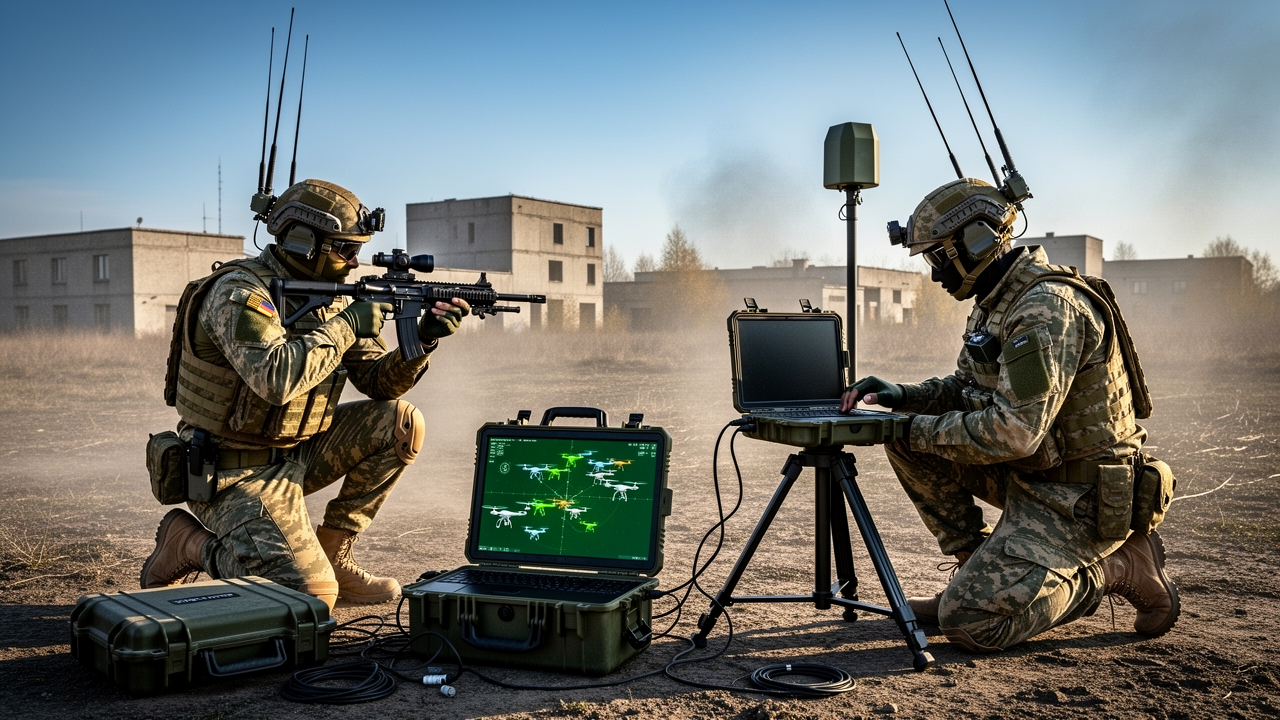
Guarding the Skies: How the 400M Instantaneous Bandwidth Signal Generator Empowers Counter-UAS Defense
Introduction
Recent news regarding Counter-Unmanned Aircraft Systems C-UAS continues to draw attention, particularly concerning operations in guarding the eastern flank and other important strategic areas, where the development and deployment of counter-UAS technology have become a focal point. This reflects the increasingly severe drone threats in a global geopolitical tense environment, and the urgent demand for efficient C-UAS solutions across nations. Traditional defense methods are facing severe challenges, and the need for innovative technologies is unprecedented.
Industry Challenges & Pain Points
Currently, unauthorized drones, including small consumer drones and advanced military UAVs, have become a major threat to military, civilian, and critical infrastructure security. These drones can perform reconnaissance, intelligence gathering, and even carry out attack missions. Traditional defense systems often struggle to respond effectively due to fixed frequencies and slow reaction times. UAV technology is evolving rapidly, including swarm attacks, frequency hopping communications, and low-observable designs, rendering narrowband, single-frequency jamming equipment ineffective. How to effectively detect, identify, and rapidly counter these complex and diverse aerial threats is a pressing industry challenge.
The Core Countermeasure: Why a Signal Interference Source is Key
In Counter-UAS systems, the signal interference source is considered the most critical component. It jams the communication link between a drone and its operator or interferes with its navigation systems, such as GPS, by emitting wideband or directional jamming signals, thereby causing it to lose control or return to base. To effectively counter ever-evolving drone threats, the interference source must possess wideband coverage capabilities and frequency agility. This means it must not only cover all commonly used drone frequency bands but also be able to rapidly adjust jamming frequencies and modes according to the threat type, achieving precise and efficient countermeasures.
Advanced Solution: 400M Instantaneous Bandwidth Signal Generator
Addressing the aforementioned challenges, the 400M Instantaneous Bandwidth Signal Generator offers an ideal solution. This device features an ultra-wide frequency range of 70-6000MHz, ensuring comprehensive coverage of most known drone communication and navigation bands. Its 400M instantaneous bandwidth capability allows the device to simultaneously generate complex signals or jam across a very wide frequency window, effectively countering advanced threats like frequency hopping and spread spectrum. Furthermore, its software-tunable frequency characteristic provides the system with extremely high flexibility and adaptability, enabling rapid programming and deployment of new jamming strategies based on real-time battlefield situations and threat characteristics. This allows C-UAS systems to quickly upgrade and respond to potentially unknown future drone threats, significantly enhancing defensive effectiveness.
Conclusion
Facing increasingly complex drone threats, traditional defense methods are proving insufficient. The 400M Instantaneous Bandwidth Signal Generator, with its wide frequency coverage, large instantaneous bandwidth, and advanced software-tunable frequency characteristics, stands as a key technology for building next-generation efficient Counter-UAS systems. It provides strong technical support for safeguarding national security and critical infrastructure.
Contact us today to learn how the 400M Instantaneous Bandwidth Signal Generator can enhance your Counter-UAS capabilities.
FAQ
Question 1: What are the main application scenarios for the 400M Instantaneous Bandwidth Signal Generator
Answer 1: It is primarily applied in Counter-UAS systems, electronic warfare, radar testing, and communication jamming, providing solutions for various scenarios requiring wideband, high-precision signal generation.
Question 2: What advantages does the software-tunable frequency feature offer for Counter-UAS systems
Answer 2: The software-tunable frequency feature enables Counter-UAS systems to quickly adjust jamming strategies according to constantly changing drone communication protocols and frequencies, enhancing system flexibility, adaptability, and countermeasure efficiency to effectively address unknown threats.
