

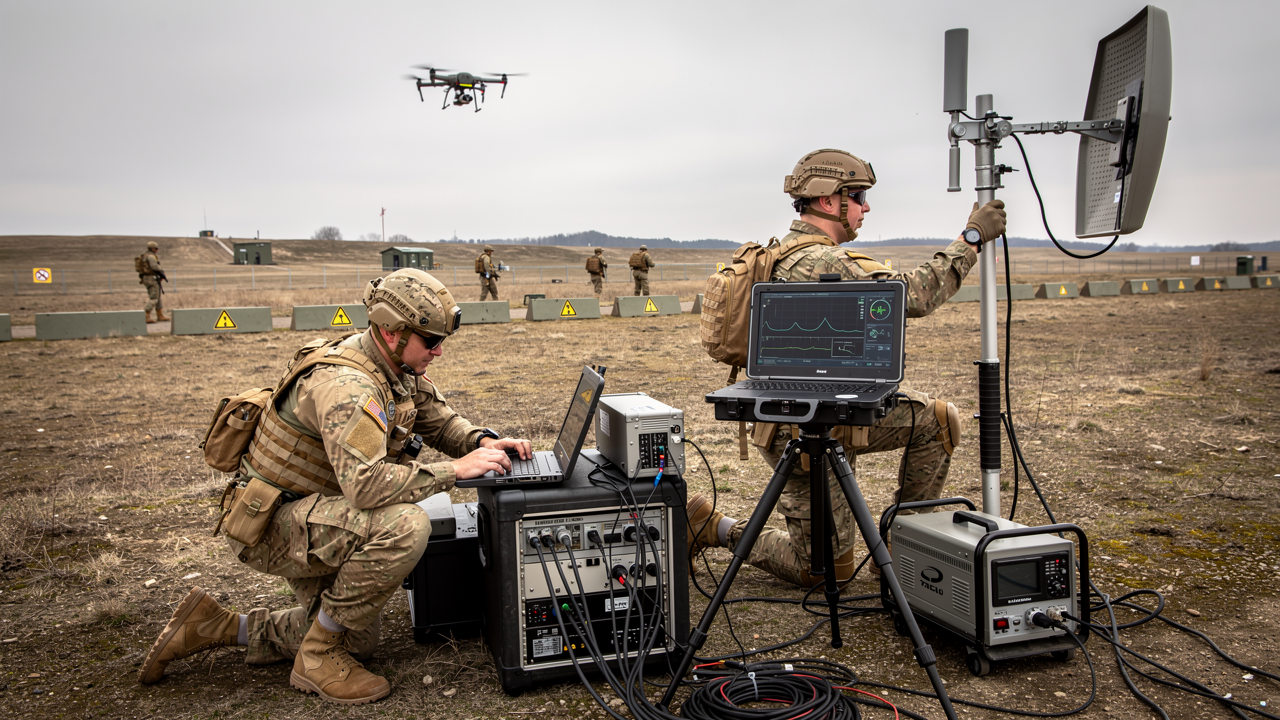
Countering Drone Threats: How a 400M Instantaneous Bandwidth Signal Generator Enhances Counter-Drone Systems
Introduction
Recently, the US Pentagon launched its Replicator 2 initiative, aiming to accelerate the procurement and deployment of thousands of counter-drone systems. This move highlights a global urgent response to the growing drone threat. As drone technology rapidly advances, from reconnaissance to attack, its applications are becoming increasingly widespread, posing unprecedented challenges to national security and critical infrastructure. The Pentagon action aims to deploy more adaptable and cost-effective solutions through rapid innovation to address this dynamic and evolving threat.
Industry Challenges & Pain Points
Currently, unauthorized drone activities and evolving UAV technology present severe challenges to the defense and security sectors. Traditional defensive methods are often limited to fixed frequency ranges and narrow bandwidths, struggling to effectively counter drones equipped with advanced capabilities like frequency hopping or spread spectrum. These systems lack rapid response and frequency adaptability, proving ineffective against diverse or swarming drone threats. The common industry challenge lies in how to effectively interfere with and suppress these wideband, intelligent aerial targets.
The Core Countermeasure: Why Signal Interference Source is Key
In counter-drone systems, the signal interference source is the core element determining its effectiveness. Effective countermeasures are not merely physical interception but critically involve rendering drones ineffective through powerful electronic interference. To successfully combat modern drones, interference sources must possess broad frequency coverage capabilities and excellent frequency agility. Only then can they effectively suppress various communication, navigation, and control signals used by drones, severing their connection with operators, or causing navigation failure. Wideband interference is particularly crucial as it can simultaneously cover multiple potential threat frequencies, significantly increasing the success rate of countermeasures.
Advanced Solution: 400M Instantaneous Bandwidth Signal Generator
To address the aforementioned challenges, we proudly introduce the 400M Instantaneous Bandwidth Signal Generator, a powerful tool specifically designed for modern counter-drone systems. This device features an ultra-wide frequency range of 70-6000MHz, ensuring coverage of all commonly used drone frequency bands. Its 400M instantaneous bandwidth capability allows the device to simultaneously process and generate wideband interference signals, effectively suppressing complex and varied drone communications. More importantly, this signal generator supports software-defined frequency modulation, meaning users can quickly adjust output frequency and modulation methods via software based on real-time threat situations, without hardware changes. This flexibility and adaptability make it an ideal choice for counter-drone deployments.
Conclusion
Facing increasingly complex drone threats, traditional defensive measures are proving insufficient. The Pentagon Replicator 2 initiative and the pursuit of advanced counter-drone technology clearly indicate the future direction of defense. Our 400M Instantaneous Bandwidth Signal Generator is an innovative product aligned with this trend, providing crucial support for building an impregnable counter-drone defense line with its exceptional performance and flexibility.
Learn more today about how our 400M Instantaneous Bandwidth Signal Generator can enhance your defensive capabilities. Contact our expert team for detailed information.
FAQ
Question 1: What exactly is instantaneous bandwidth?
Answer 1: Instantaneous bandwidth refers to the maximum signal bandwidth a signal generator can process or generate at any given moment. For counter-drone applications, greater instantaneous bandwidth means it can simultaneously interfere with a wider frequency range, being more effective against frequency-hopping or spread-spectrum drones.
Question 2: What are the advantages of software-defined frequency modulation?
Answer 2: Software-defined frequency modulation allows users to rapidly and flexibly adjust the signal frequency, power, and modulation type via software, without physically replacing hardware. This offers a decisive advantage in responding to constantly changing drone threats and unknown frequency bands, significantly shortening response times.
References
- Meritalk Article (https://meritalk.com/articles/pentagon-makes-first-replicator-2-counter-drone-buy/)
