

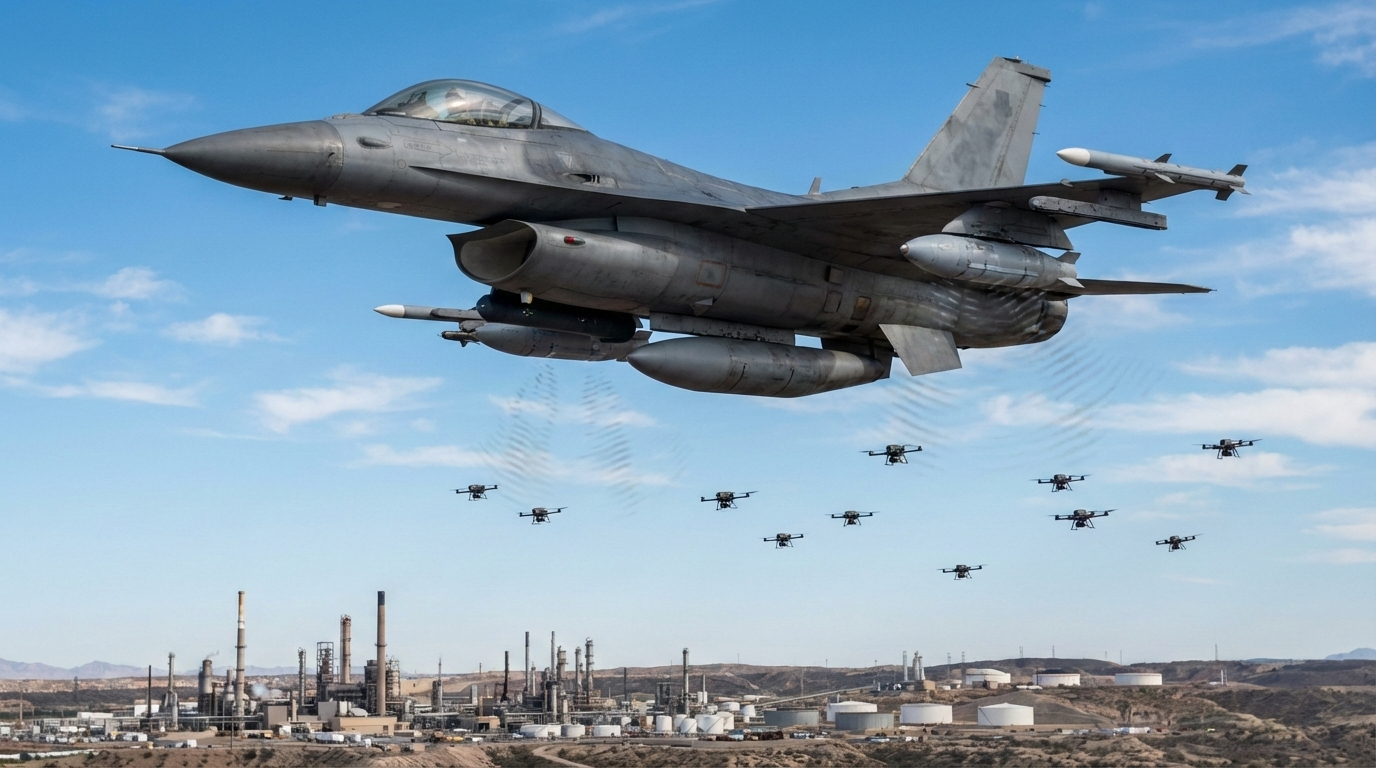
F-16 Drone Swarm Counter: Detailing the US Militarys New C-UAS Strategy
Introduction
With the rapid development of drone technology and its increasing prevalence in modern conflicts, the new threat posed by drone swarms forces militaries worldwide to seek innovative defensive strategies. The US military is embarking on an ambitious plan to upgrade its proven F-16 fighter jets, endowing them with powerful F-16 drone swarm counter capabilities to effectively deal with the growing drone swarm threat. This initiative marks a crucial step for the US in the realm of Counter-Unmanned Aircraft Systems (C-UAS), aiming to leverage the technological potential of existing platforms to meet future battlefield challenges.
Project VENOM and the F-16s Transformation
Project VENOM (Viper Experimentation and Next-generation Operations Model) is a program under the US Air Force Life Cycle Management Center (AFLCMC). Its core objective is to transform F-16 fighter jets into effective adversaries against drone swarms. The project leverages the flexibility of the F-16s Open Architecture Mission System (OAMS) to enable rapid technological iteration and integration. This means the F-16 can detect, track, and suppress enemy drone swarms through advanced electronic warfare systems and sensors. This transformation not only extends the F-16s service life but also grants it critical capabilities for C-UAS missions in complex electromagnetic environments.
Application of Electronic Warfare and Multi-Domain Operations
The core of the F-16 drone swarm counter strategy lies in powerful electronic warfare capabilities. By integrating advanced EW pods and software-defined radio technology, the F-16 can jam, deceive, and even incapacitate enemy drones and their communication links. This non-kinetic attack method effectively disrupts the collaborative capabilities of drone swarms while avoiding collateral damage. Furthermore, the F-16, as a manned platform, can operate synergistically with unmanned wingmen (such as the Skyborg program) to form manned/unmanned teams, providing broader situational awareness and strike options in multi-domain operational environments, further enhancing its anti-drone swarm efficiency and battlefield survivability.
Conclusion
Transforming the F-16 fighter jet into a drone swarm counter platform is a vital strategic move for the US military to adapt to modern battlefield threats. Through the fusion of Project VENOM and advanced electronic warfare technologies, the F-16 is expected to continue playing a crucial role in the global security landscape, effectively addressing future potential drone swarm challenges and maintaining air superiority.
FAQ
Question 1: What main problem does the F-16 drone swarm counter project address?
Answer 1: This project primarily addresses the increasing threat posed by drone swarms on the modern battlefield, transforming F-16 fighter jets to equip them with the ability to identify, track, and suppress large numbers of drones.
Question 2: What role does Project VENOM play in the F-16s transformation?
Answer 2: Project VENOM is a key program driving the modernization of F-16 fighter jets and the integration of new C-UAS technologies, leveraging an open architecture mission system for rapid iteration and deployment of electronic warfare and sensor upgrades.
References
- National Security Journal (https://nationalsecurityjournal.org/the-u-s-military-has-a-plan-to-transform-f-16-fighters-into-drone-swarm-destroyers/)
Related Content
- Future Developments in Drone Defense Systems (URL)
- Electronic Warfare Technology in Air Combat (URL)
