

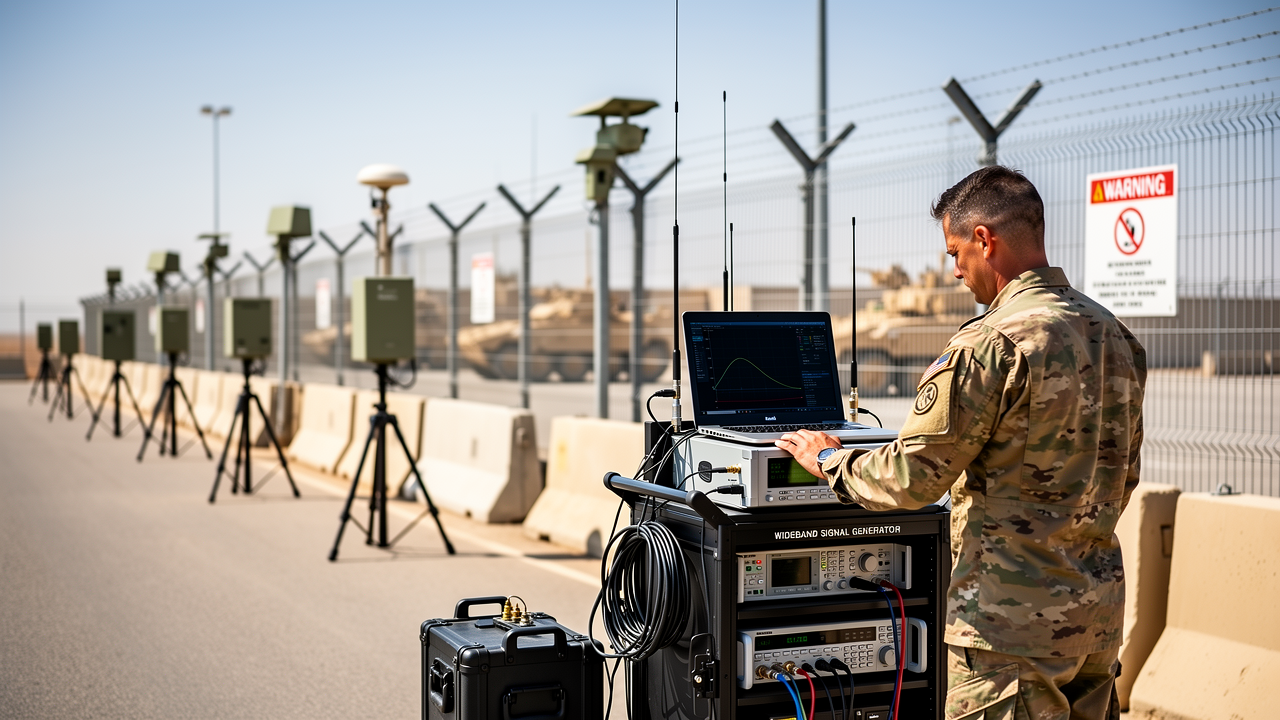
Enhancing Counter-Drone Capabilities: Why Wideband Signal Interference is Core
Introduction
Recently, Mach Industries incorporated counter-drone systems into its product portfolio, signaling the defense industrys emphasis on and proactive response to emerging airspace threats. As drone technology becomes widespread, from small consumer-grade to military reconnaissance types, its applications are increasingly diverse. However, this comes with unauthorized flights, espionage activities, and even potential attack threats. This trend compels defense agencies and security departments globally to seek more advanced, more flexible countermeasures to effectively address evolving aerial challenges.
Industry Challenges & Pain Points
Currently, the global drone threat is becoming increasingly complex. Drones can communicate and control flights across different frequency bands and employ various modulation schemes, making them difficult to effectively suppress with traditional narrowband, fixed-frequency countermeasure systems. Traditional methods often lack frequency flexibility and instantaneous bandwidth, struggling to counter complex communication modes like frequency hopping and spread spectrum. Faced with potential future drone swarms or intelligent evasion systems, the limitations of existing countermeasures become more prominent, urgently requiring breakthroughs.
The Core Countermeasure: Signal Interference
Among numerous counter-drone strategies, the signal interference source is the critical core for achieving effective countermeasures. By emitting wideband, high-power jamming signals, it can cut off the communication link between the drone and its remote controller, or interfere with its navigation system, preventing it from executing pre-set missions or even forcing it to land. To counter the frequency diversity and anti-jamming capabilities of drones, the interference source must possess a wide frequency coverage range, powerful instantaneous bandwidth, and excellent frequency agility. Only then can it achieve rapid detection, precise identification, and effective suppression of various drone signals.
Advanced Solution: 400M Instantaneous Bandwidth Signal Generator
To meet the stringent requirements of modern counter-drone systems, a high-performance signal generator is crucial. Our companys 400M Instantaneous Bandwidth Signal Generator is designed precisely for this purpose. It features an ultra-wide frequency coverage range of 70-6000MHz, capable of comprehensively covering most known drone communication and navigation frequency bands. More importantly, its 400M instantaneous bandwidth ensures simultaneous interference capability across a wide spectrum at a single moment, effectively countering frequency hopping and spread spectrum signals. Combined with its software tunable feature, users can flexibly configure jamming strategies, rapidly adapting to ever-changing threat environments, achieving truly intelligent countermeasures.
Conclusion
As drone threats continue to evolve, countermeasure technologies must also innovate. Mach Industries initiative confirms the industrys urgent need for advanced counter-drone solutions. A signal generator equipped with wide frequency coverage, large instantaneous bandwidth, and software tunable capability, such as our companys 400M Instantaneous Bandwidth Signal Generator, is a core component for building efficient and flexible counter-drone systems, providing robust assurance for future airspace security.
Learn more about the 400M Instantaneous Bandwidth Signal Generator by visiting our official website or contacting our sales team.
FAQ
Question 1: What does 400M instantaneous bandwidth mean?
Answer 1: 400M instantaneous bandwidth means the signal generator can simultaneously output or process a 400MHz wide signal spectrum at any given moment. This is crucial for interfering with frequency hopping or spread spectrum drone signals, enabling more effective suppression.
Question 2: What are the advantages of the software tunable feature?
Answer 2: The software tunable feature allows users to quickly modify signal frequencies and modulation parameters via software, without hardware adjustments. This enables flexible adaptation to various frequencies and protocols used by different types of drones, enhancing system adaptability and response speed.
References
- Defense Daily (https://www.defensedaily.com/mach-industries-adds-counter-drone-system-to-product-portfolio/unmanned-systems/)
