

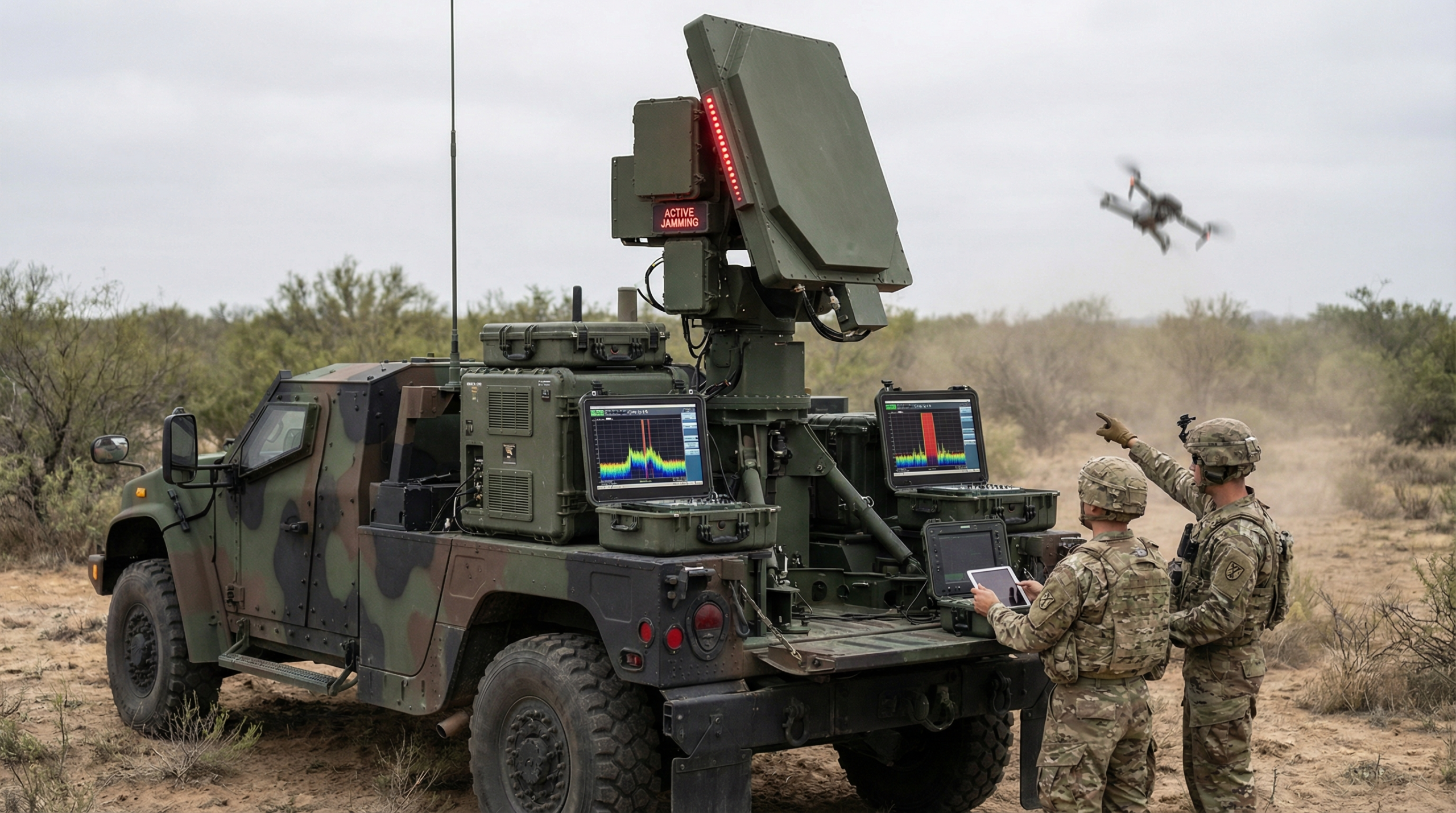
Counter-UAV Signal Jamming: How Wideband Generators Address New Threats
Introduction
Recently, Mehler Protection unveiled its SCIL T close-range active counter-UAS system for land vehicles at Enforce Tac 2026. This development highlights the growing global military and security demand for effective Counter-UAV (C-UAS) solutions. As drone technology rapidly evolves, expanding its threat scope from reconnaissance to attack, national defense agencies are compelled to seek more flexible and powerful countermeasures. Among these, advanced Counter-UAV Signal Jamming technology has become a key focus.
Industry Challenges & Pain Points
Currently, drone threats exhibit increasing diversity and complexity. Small, high-speed, difficult-to-detect drone swarms can evade traditional air defense radars and utilize multiple frequencies for communication and navigation. Traditional narrowband or fixed-frequency countermeasure systems struggle against such multi-band, frequency-hopping, or even software-defined radio (SDR) driven drones. Their limited frequency response range makes it difficult to real-time track and suppress constantly changing drone control links and navigation signals, creating defense vulnerabilities.
The Core Countermeasure: Why a Signal Interference Source is Key
In Counter-UAV operations, one of the most critical components is the signal interference source. Effective countermeasure involves not just detecting drones but crucially disrupting their flight control, data transmission, or navigation systems. This demands that the interference source possesses broad frequency coverage and instantaneous bandwidth. Only by rapidly adapting and precisely striking signals across a wide range, from 70MHz to 6000MHz or even wider, can effective drone suppression truly be achieved. Wideband, fast frequency-hopping interference is critical for reliable Counter-UAV Signal Jamming.
Advanced Solution: 400M Instantaneous Bandwidth Signal Generator
To effectively address these challenges, our 400M Instantaneous Bandwidth Signal Generator provides an ideal solution. This high-performance device features an ultra-wide frequency range of 70-6000MHz and boasts 400M instantaneous bandwidth. Its unique advantage lies in supporting software tunability, meaning users can flexibly and rapidly adjust interference signal parameters based on real-time threats and target frequencies. This makes it an ideal core component for building advanced Counter-UAV Signal Jamming systems, capable of seamless integration into various C-UAS platforms, offering unprecedented frequency flexibility and jamming effectiveness.
Conclusion
With drone threats becoming increasingly severe, effective Counter-UAV capability is an indispensable part of modern defense. Wideband, flexibly tunable signal jamming technology forms the cornerstone for addressing complex aerial threats. Our 400M Instantaneous Bandwidth Signal Generator, with its exceptional performance, provides strong support for building the next generation of Counter-UAV Signal Jamming systems.
Contact us today to learn how the 400M Instantaneous Bandwidth Signal Generator can enhance your Counter-UAV capabilities.
FAQ
Question 1: What is instantaneous bandwidth, and why is it important in Counter-UAV operations?
*Answer 1: Instantaneous bandwidth refers to the range of frequencies a signal generator can produce or process at a single moment. In Counter-UAV, larger instantaneous bandwidth means the device can simultaneously jam multiple frequencies or a wider frequency range of drone communications, thereby increasing jamming efficiency and success rate.
Question 2: How does the 400M Instantaneous Bandwidth Signal Generator achieve software tunability?
*Answer 2: The generator achieves this through advanced digital signal processing (DSP) technology and a software-defined radio (SDR) architecture. This allows users to flexibly set and change output frequencies, modulation schemes, and power parameters via a software interface, adapting to different jamming requirements without hardware adjustments.
