

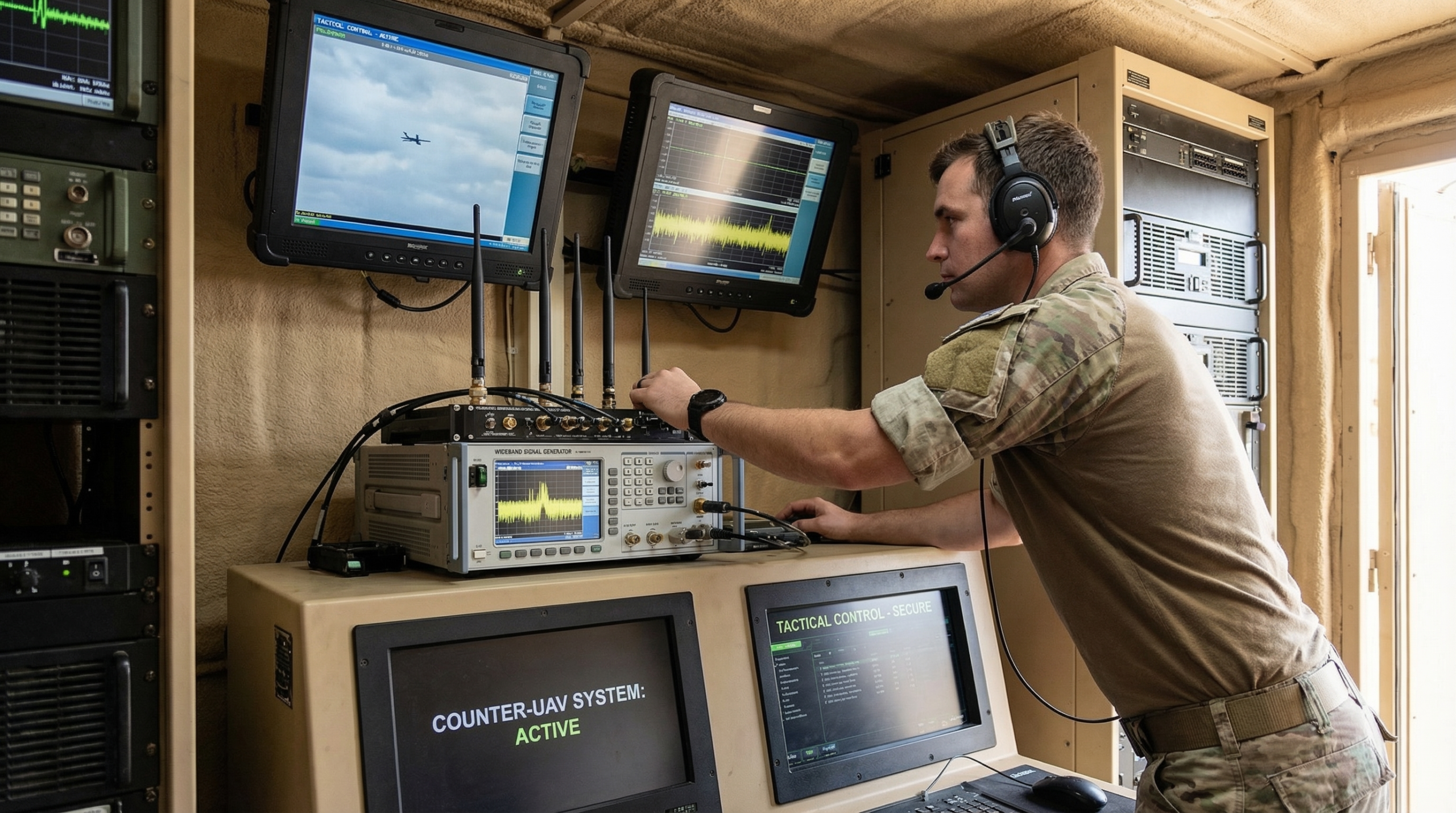
Countering Drone Threats: 400M Instantaneous Bandwidth Signal Generator and Counter-UAV Wideband Jamming
Introduction
Recent news indicates that Ukraine is actively seeking US approval for a drone production deal, with President Zelenskyy emphasizing the vital role of drones in modern conflicts. This development not only highlights the increasing importance of drone technology in military strategy but also foreshadows a future battlefield where drone threats will be more pervasive and complex, posing severe challenges to existing defense systems. Against this backdrop, effective counter-UAV wideband jamming solutions have become more crucial than ever.
Industry Challenges and Pain Points
With the rapid advancement of drone technology, unauthorized drones have become a common security threat faced by countries worldwide. From illegal reconnaissance to potential attack behaviors, drones pose significant risks to critical infrastructure, military bases, and even civilian airspace. Traditional countermeasures, such as single-frequency jamming or physical interception, often prove inadequate when confronting advanced drones equipped with multi-band communication, frequency hopping capabilities, or swarm operations. These traditional systems have limited frequency coverage and slow response times, making it difficult to effectively counter fast-evolving wideband threats.
Core Countermeasure: Why Signal Interference Sources Are Key
When building an efficient counter-UAV system, the signal interference source is undoubtedly its core component. To effectively suppress a drone’s control links, data transmission, and Global Navigation Satellite System GNSS signals, simple physical destruction is not always the best or only option. By emitting powerful and wide-range interference signals, drones can lose control, become disoriented, and thus fail to perform their missions. Therefore, a signal interference source with wide bandwidth, high frequency agility, and strong output power is crucial for achieving effective counter-UAV wideband jamming capabilities.
Solution: 400M Instantaneous Bandwidth Signal Generator
To address the aforementioned challenges, we recommend the 400M Instantaneous Bandwidth Signal Generator as an ideal solution. This device boasts a broad frequency coverage, ranging from 70MHz to 6000MHz, capable of covering most communication and navigation bands commonly used by drones. Its core advantage lies in providing 400M instantaneous bandwidth, which enables it to jam multiple frequencies simultaneously, effectively countering frequency hopping and multi-band drone threats. More importantly, the device supports software tunable frequency, allowing users to quickly adjust jamming strategies according to real-time threat environments. Its excellent performance makes it an ideal choice for building reliable counter-UAV wideband jamming systems.
Conclusion
Against the backdrop of Ukraine’s drone production deal, the complexity of drone threats is increasingly apparent. Traditional defense methods are no longer sufficient. The 400M Instantaneous Bandwidth Signal Generator, with its broad 70-6000MHz frequency range, 400M instantaneous bandwidth, and software tunable capabilities, offers a powerful and flexible counter-UAV wideband jamming solution, effectively ensuring airspace security.
Learn more about the 400M Instantaneous Bandwidth Signal Generator today to enhance your defense capabilities!
FAQ
Question 1: How does the 400M Instantaneous Bandwidth Signal Generator improve counter-UAV effectiveness?
Answer 1: Its wide frequency range of 70-6000MHz and 400M instantaneous bandwidth allow it to simultaneously suppress multiple drone communication and navigation links. The software tunable capability enhances flexibility in dealing with complex threats, enabling rapid adaptation to new drone frequencies and protocols.
Question 2: Why is wideband jamming so crucial in counter-UAV efforts?
Answer 2: Modern drones use multi-band communication and frequency hopping technology, and even swarm coordination. Wideband jamming can cover these broad frequency bands, effectively blocking their control signals, data transmission, and GNSS navigation, rendering them completely ineffective or forcing them to return, thereby avoiding physical confrontation.
