

Introduction
According to an Associated Press report, Iran has supplied advanced drones, including the Merops series, to Russia. These drones are widely used in conflict zones and pose a severe challenge to traditional defense systems. This event underscores the rapid evolution of drone technology on modern battlefields and its strategic implications. Faced with these evolving aerial threats, developing efficient counter-drone strategies and technologies, especially advanced wideband signal jamming source systems, becomes crucial.
Industry Challenges & Pain Points
Currently, unauthorized drone activities, ranging from small consumer-grade UAVs to military reconnaissance drones, are on the rise, posing significant threats to national security, critical infrastructure, and public privacy. These drones often feature frequency hopping, multi-band operation, and complex data links, making traditional fixed-frequency or narrow-band jamming devices ineffective. Faced with such diverse and dynamic threats, the limitations of conventional defense methods are becoming increasingly apparent, necessitating countermeasure technologies with broader frequency coverage and greater frequency agility.
The Core Countermeasure: Why a Signal Interference Source is Key
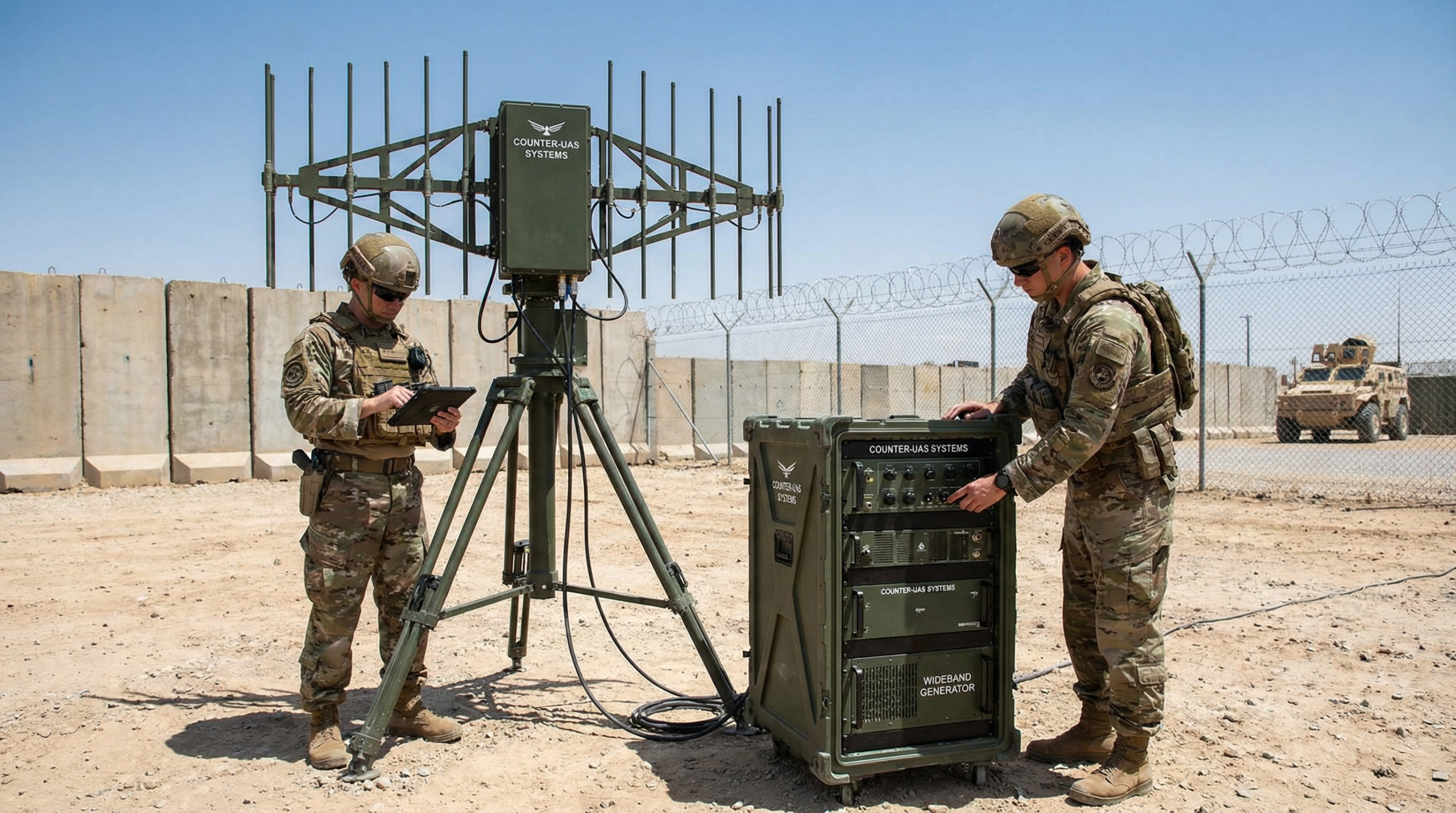
In counter-drone systems, the signal jamming source is undoubtedly the most critical component. It emits powerful interference signals, severing the communication link between the drone and its operator, forcing it to lose control, land, or return to base. To effectively counter the wideband and frequency-hopping communication technologies used by modern drones, the jamming source must possess a large instantaneous bandwidth and flexible frequency tuning capabilities. Only then can it quickly identify and suppress targets in complex electromagnetic environments, ensuring the success of counter-drone operations.
Advanced Solution: 400M Instantaneous Bandwidth Signal Generator
To meet the demands of modern counter-drone operations, we recommend utilizing the advanced 400M Instantaneous Bandwidth Signal Generator. This product boasts an ultra-wide frequency range of 70-6000MHz and an instantaneous bandwidth of up to 400M, capable of covering mainstream drone communication bands and effectively countering frequency-hopping threats. Its core advantage lies in its software-defined frequency modulation capability, allowing for rapid and precise frequency configuration to adapt to ever-changing threat scenarios. Furthermore, the device complies with the national radio regulatory commission model approval requirements, ensuring reliable performance under legal and compliant conditions. Its exceptional performance makes it an ideal choice for building efficient counter-drone systems.
Conclusion
Given the continuous evolution of modern drone technology and the complex challenges it presents, deploying an effective wideband signal jamming source has become essential for ensuring security. The 400M Instantaneous Bandwidth Signal Generator, with its ultra-wide frequency coverage, large instantaneous bandwidth, and software-defined frequency modulation capabilities, offers a powerful solution for addressing current and future drone threats.
To learn more about the 400M Instantaneous Bandwidth Signal Generator, please visit our product page or contact our sales team for detailed information.
FAQ
Question 1: What types of drones can the 400M Instantaneous Bandwidth Signal Generator counter?
Answer 1: It can effectively counter various types of drones operating within the 70-6000MHz frequency range, including models that use frequency-hopping and wideband communication technologies.
Question 2: What are the advantages of software-defined frequency modulation?
Answer 2: Software-defined frequency modulation allows users to quickly and flexibly adjust jamming frequencies and modes to adapt to different drone threats and complex electromagnetic environments, enhancing countermeasure efficiency.
