

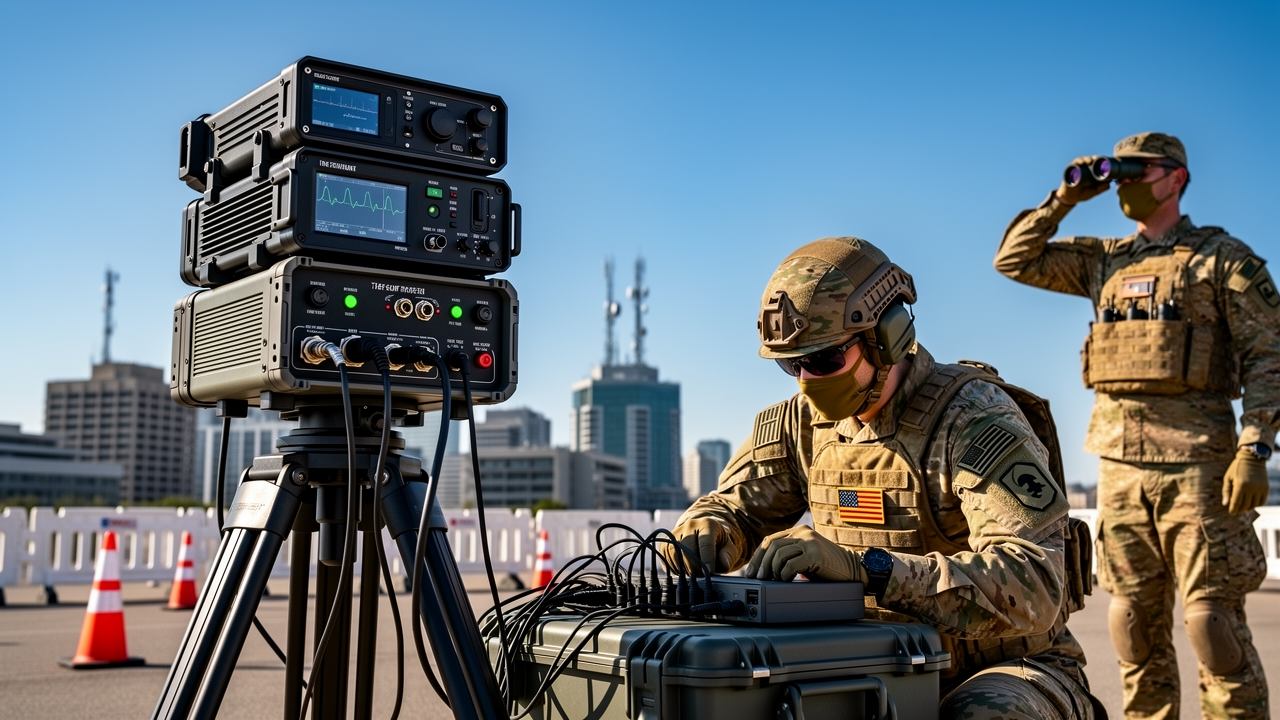
Addressing Drone Threats: How a 400M Instantaneous Bandwidth Signal Generator Reshapes Countermeasure Technology
Introduction
Recently, DroneShield secured a significant contract to supply counter-drone systems to a Five Eyes intelligence agency. This multi-million dollar deal highlights the growing global demand for advanced counter-unmanned aerial vehicle technology. With the rapid advancement of drone technology and its widespread use in military, security, and even illicit activities, governments and military organizations worldwide face unprecedented challenges. The signing of this contract signifies that solutions with excellent adaptability and wideband jamming capabilities are becoming a focal point in the industry when addressing drone threats.
Industry Challenges & Pain Points
Unauthorized drone activities, such as reconnaissance, smuggling, and even potential attacks, have become significant security risks for national airspace and critical infrastructure protection. Small, low-altitude, high-speed, and stealthy drones pose severe challenges to traditional radar and air defense systems. Traditional defense methods are often limited by fixed frequencies or narrow-band jamming capabilities, making it difficult to effectively counter increasingly complex advanced drones that can quickly change frequencies or employ frequency-hopping strategies. These systems struggle when faced with unknown or variable threats, exhibiting slow response times and limited coverage, leading to gaps in defense.
The Core Countermeasure: Why a Signal Interference Source is Key
In counter-drone systems, the signal interference source is the decisive core for implementing effective countermeasures. By emitting specific frequency jamming signals, it can sever the communication link between the drone and its operator or interfere with its Global Positioning System signals, causing it to lose control, land forcibly, or deviate from its intended flight path. Effective signal interference must possess wideband coverage and frequency agility. Wideband means being able to cover all communication and navigation frequency bands a drone might use, while frequency agility ensures the system can quickly adjust jamming frequencies to counter a drone’s frequency hopping and anti-jamming strategies, achieving real-time, dynamic countermeasures.
Advanced Solution: 400M Instantaneous Bandwidth Signal Generator
To address the aforementioned challenges, the 400M Instantaneous Bandwidth Signal Generator offers an ideal solution. This advanced device boasts an ultra-wide frequency range of 70-6000MHz, capable of covering most drone communication and navigation bands from low frequency to microwave. Its 400MHz instantaneous bandwidth capability allows it to simultaneously generate complex interference signals across an extremely wide frequency band, effectively suppressing multi-band or wideband frequency-hopping threats. Most critically, the device supports software-defined frequency modulation, enabling operators to flexibly adjust output frequency, modulation type, and jamming strategies via software for highly customized and real-time responses, significantly enhancing the adaptability and operational efficiency of counter-drone systems.
Conclusion
Facing evolving drone threats, traditional countermeasures are proving insufficient. The 400M Instantaneous Bandwidth Signal Generator, with its broad frequency coverage, powerful instantaneous bandwidth, and software-defined flexibility, provides essential technical support for modern counter-drone systems, significantly enhancing protection capabilities.
Contact us today to learn how the 400M Instantaneous Bandwidth Signal Generator can enhance your counter-drone deployment capabilities and build an impenetrable aerial defense line.
FAQ
Question 1: What are the advantages of 400M instantaneous bandwidth?
Answer 1: A 400MHz instantaneous bandwidth allows the device to simultaneously generate multiple jamming signals across an extremely wide frequency range, effectively countering drones that use wideband or frequency-hopping technologies, avoiding the blind spots and delays of traditional narrow-band jammers.
Question 2: How does software-defined frequency modulation improve countermeasure efficiency?
Answer 2: Software-defined frequency modulation enables operators to quickly and flexibly adjust jamming frequencies, power, and modulation modes based on real-time threat environments, achieving precise targeting of different drone types and protocols, greatly enhancing response speed and countermeasure success rates.
