

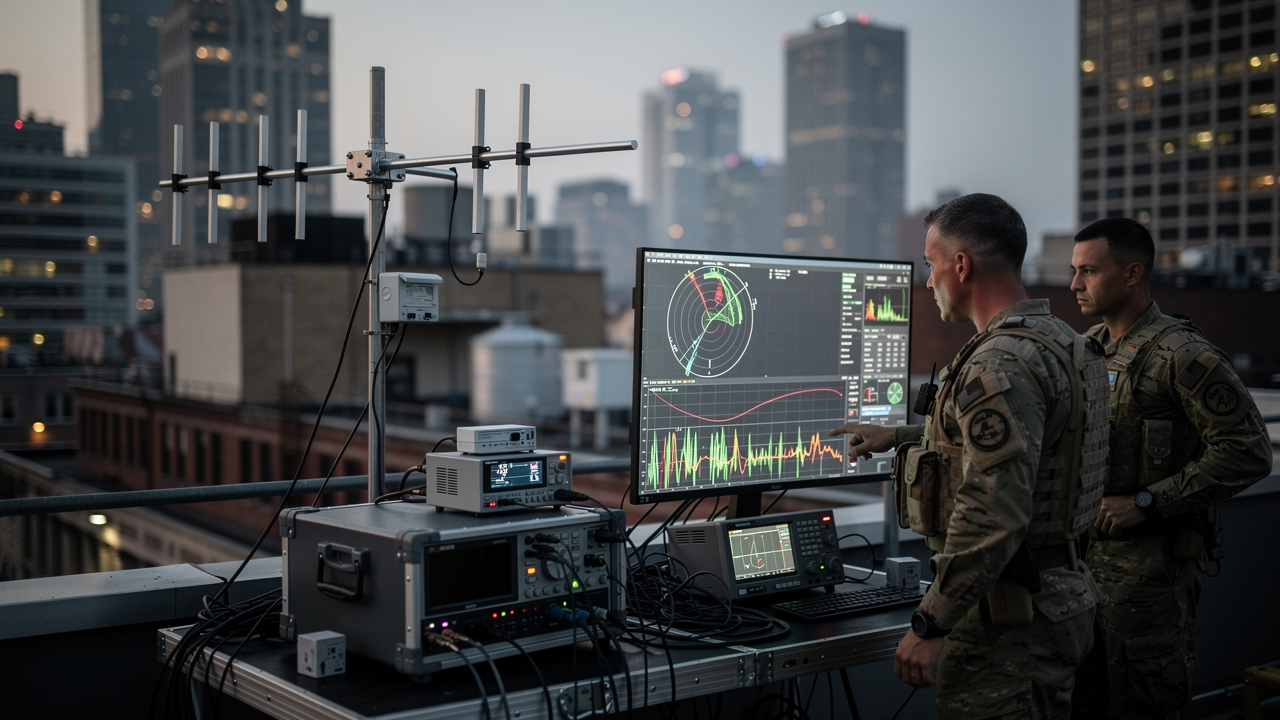
Countering Drone Threats: The Critical Role of the 400M Instantaneous Bandwidth Signal Generator in Counter-UAS
Introduction
The US Department of Homeland Security (DHS) recently launched a new counter-UAS (C-UAS) agency, aiming to integrate and coordinate counter-drone efforts across various departments. This initiative reflects a deep understanding of the growing threat posed by unmanned aircraft systems (UAS), especially those that could be used for malicious purposes. DHS is seeking a more systematic and centralized approach to protect critical infrastructure and public safety, effectively addressing the challenges presented by drones.
Industry Challenges and Pain Points
Currently, unauthorized drone activities, rogue flights, and security risks stemming from advancements in small UAV technology are increasingly prominent worldwide. These threats pose severe challenges to national security, critical infrastructure protection, and public order. Traditional countermeasure systems often rely on fixed-frequency jamming methods, which renders them inadequate when facing multi-band, frequency hopping, or wideband drone threats. The rapid evolution of drone technology means fixed-frequency jamming measures can be easily circumvented, thereby weakening defensive effectiveness.
Core Countermeasure: Why the Signal Interference Source is Key
In building efficient counter-UAS systems, the signal interference source, specifically the jamming transmitter, holds a central position. Its importance lies in its ability to suppress or interfere with a drones remote control, navigation, or video transmission signals by emitting specific signals, causing it to lose control or fail to perform its intended mission. For effective countermeasures, the signal interference source must possess wideband coverage, high instantaneous bandwidth, and the flexibility for rapid frequency adjustment to adapt to complex and dynamic electromagnetic environments and various types of drone threats.
Solution: 400M Instantaneous Bandwidth Signal Generator
Addressing the industry pain points mentioned above, the 400M Instantaneous Bandwidth Signal Generator offers an ideal solution. This device features a broad frequency coverage range of 70-6000MHz, ensuring it can cover most drone communication bands currently on the market. Its 400MHz instantaneous bandwidth capability enables it to perform efficient signal jamming across a wide frequency band simultaneously, particularly effective against frequency hopping and spread spectrum drones. Crucially, the device supports software tunable frequency modulation, providing operators with immense flexibility to dynamically adjust jamming strategies based on real-time threats, achieving precise and highly effective signal suppression.
Conclusion
Facing complex drone threats, the establishment of the new DHS agency and advanced technologies like the 400M Instantaneous Bandwidth Signal Generator collectively form a robust defense line against future challenges. With its outstanding wideband, instantaneous bandwidth, and software tunable capabilities, this signal generator demonstrates unparalleled advantages in the field of counter-UAS signal jamming, serving as a critical tool for enhancing homeland security and public protection capabilities.
Learn more about the 400M Instantaneous Bandwidth Signal Generator today and join us in contributing to national and public safety.
FAQ
Question 1: What are the core advantages of the 400M Instantaneous Bandwidth Signal Generator?
Answer 1: The core advantages of this device lie in its broad frequency range of 70-6000MHz, an instantaneous bandwidth of up to 400MHz, and flexible software tunable capability, enabling it to efficiently address diverse and complex drone threats.
Question 2: How does this device enhance the effectiveness of counter-UAS systems?
Answer 2: By providing flexible and powerful signal interference capabilities, the 400M Instantaneous Bandwidth Signal Generator can effectively sever the drones control, navigation, or video transmission signal chain, significantly improving the overall response speed and success rate of counter-UAS systems.
