

Introduction
In recent years, drone technology has rapidly advanced, and its applications are increasingly widespread. However, the accompanying malicious use poses severe security challenges. Whether unauthorized reconnaissance, smuggling activities, or potential terrorist attacks, drones can threaten national security, critical infrastructure, and public spaces. Therefore, developing and deploying efficient Counter-UAV systems has become crucial for current and future security defense. This article will delve into modern counter-UAV technologies and how they effectively address these increasingly complex air threats.
Evolution and Challenges of Drone Threats
Initially, drones were primarily used for military reconnaissance. Today, commercial and civilian drones have significantly improved in performance, endurance, and payload capacity, and are easily accessible. This makes them more attractive for illegal activities. From micro-drones to large drones, their threat forms are diverse, including:
- Data theft and privacy invasion
- Smuggling and illegal transportation
- Interference with critical communications
- Attacks carrying dangerous items
Facing these challenges, traditional security measures are often inadequate, urgently requiring more targeted and proactive defense mechanisms.
Working Principles of Modern Counter-UAV Systems
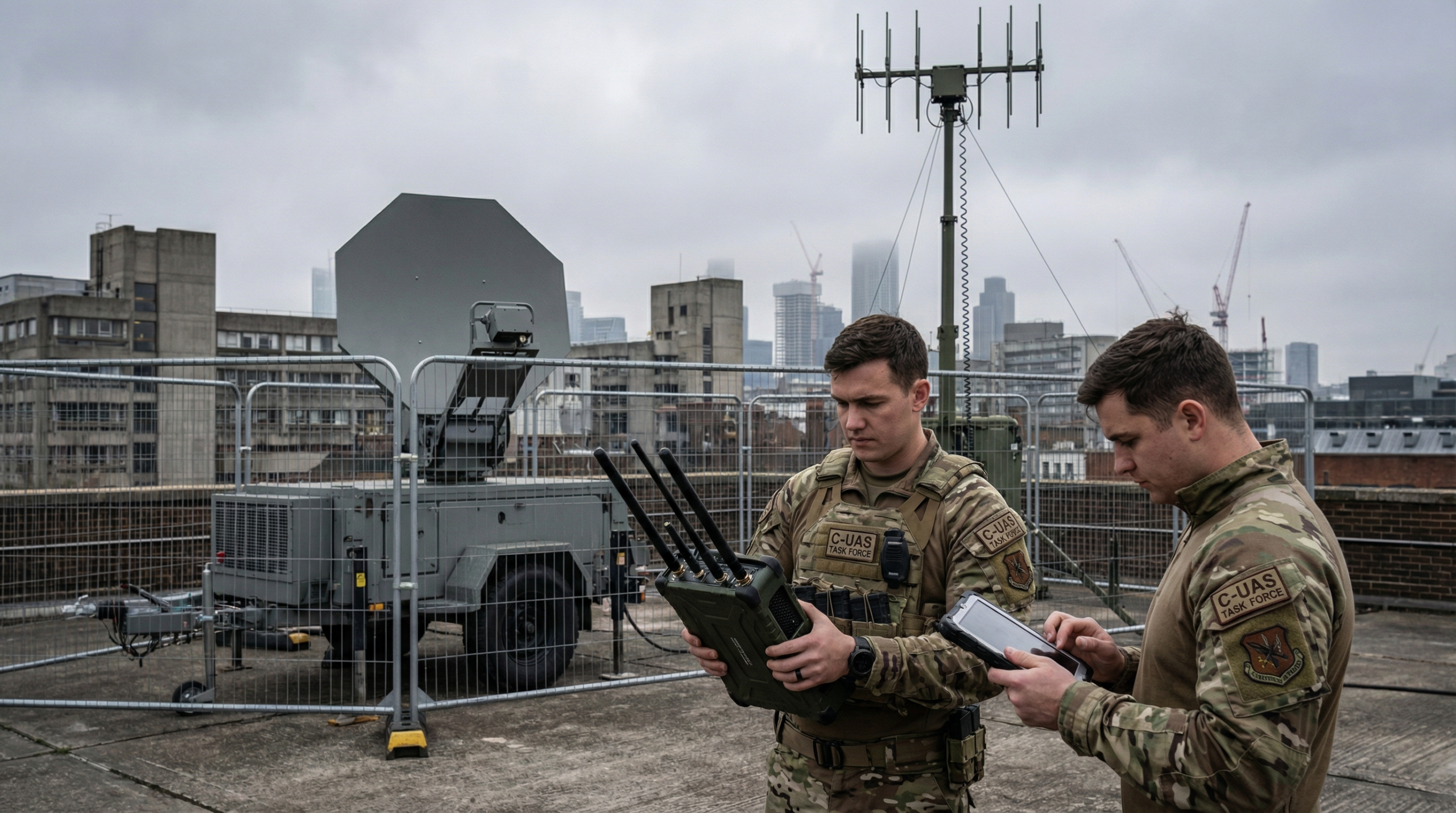
Efficient Counter-UAV systems typically integrate multiple technologies to achieve the detection, identification, tracking, and neutralization of drones. These technologies include:
- RF Detection and Jamming: By monitoring specific frequencies of radio signals, communication between drones and their operators is identified. Once a threat is detected, the system can emit powerful jamming signals to cut off the drone’s connection with its operator, forcing it to return, land, or lose control.
- Radar and Optical Tracking: Small radars can detect the physical presence and flight trajectory of drones, while high-resolution optical sensors (such as infrared cameras and high-definition visible light cameras) provide visual identification and precise tracking.
- Acoustic Detection: Identifies specific drone noise patterns by analyzing airborne sound characteristics.
- Electronic Capture and Network Hijacking: More advanced systems can simulate GPS signals or infiltrate drone control protocols to take control of a drone’s flight path or cause it to crash.
These technologies work together to form a multi-layered defense network, ensuring comprehensive coverage against various drone threats.
Conclusion
As drone technology continues to advance, the security risks posed by malicious drones will persist. Counter-UAV systems, as core tools for addressing these challenges, are of undeniable importance. Continuous technological innovation and system integration will be crucial for ensuring the safety of our skies, protecting critical assets, and maintaining public order. Future counter-UAV technologies will be more intelligent, automated, and adaptable to more complex operational environments.
FAQ
Question 1: What are the main deployment scenarios for counter-UAV systems?
Answer 1: Primarily deployed in critical infrastructure and sensitive areas with extremely high security requirements, such as airports, nuclear power plants, prisons, military bases, government buildings, and large event venues.
Question 2: How do counter-UAV systems distinguish between friendly and hostile drones?
Answer 2: Systems typically use multiple methods such as blacklisting/whitelisting mechanisms, flight authorization verification, signal feature identification, and behavior pattern analysis, combined with artificial intelligence algorithms, for differentiation.
References
- Rudaw (https://www.rudaw.net/english/world/290320261)
