

Introduction
In modern military conflicts, Electronic Warfare Defense has become a critical factor determining victory or defeat on the battlefield. With the proliferation of unmanned aerial vehicles UAVs and advanced communication technologies, the adversarys ability to use the electromagnetic spectrum for reconnaissance, jamming, and attack has significantly increased. An effective Electronic Warfare Defense system not only protects friendly communication and sensing systems from interference but also can have a major impact on adversary operations, thus gaining an advantage in a complex and ever-changing battlefield environment. This article will delve into the core concepts, technological evolution, and future challenges of Electronic Warfare Defense.
Evolution and Challenges of Electronic Warfare
From initial radio signal jamming to today’s comprehensive confrontation covering radar, GPS, satellite communication, and UAV control links, the scope and complexity of electronic warfare are unparalleled. Modern battlefields are saturated with dense electromagnetic signals, making it extremely difficult to identify, classify, and respond to threats. New challenges include:
- Spectrum Congestion: More and more devices contend for limited electromagnetic spectrum.
- Cognitive Electronic Warfare: Using artificial intelligence and machine learning to adapt to changing environments in real-time.
- UAV Threats: The reconnaissance and attack capabilities of small UAV swarms pose severe challenges to traditional defense.
- High Stealth: Low probability of intercept and low probability of detection technologies make detection more challenging.
Key Technologies and Strategies
To address these challenges, an Electronic Warfare Defense system must integrate a variety of advanced technologies and strategies:
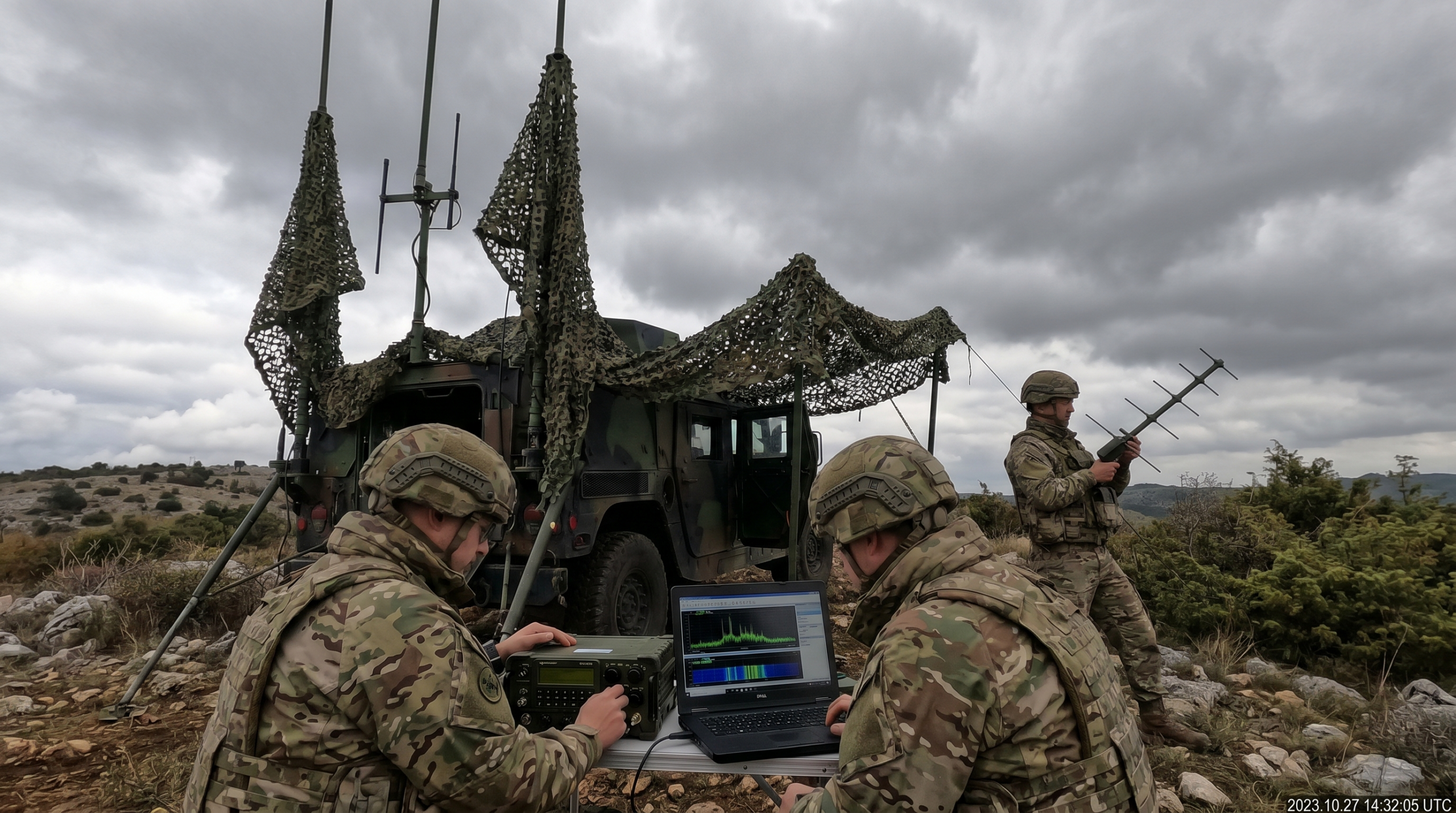
- Electronic Support ES Measures: Responsible for intercepting, identifying, and locating adversary electromagnetic radiation sources, providing friendly forces with battlefield situational awareness.
- Electronic Attack EA: Aims to reduce adversary operational effectiveness by jamming, deceiving, or destroying adversary electronic equipment.
- Electronic Protection EP: Ensures that friendly systems can still operate normally under adversary electronic attack.
- Multi-Domain Synergy: Integrates Electronic Warfare Defense with cyber warfare, information warfare, and kinetic strikes to form a comprehensive deterrent.
- Rapid Response: Systems need the ability to quickly identify new threats and develop countermeasures.
Conclusion
Electronic Warfare Defense is an indispensable part of modern military strategy. Faced with an increasingly complex electromagnetic environment and evolving threats, continuous investment in research and development, training, and integration of advanced Electronic Warfare Defense capabilities is crucial for maintaining national security and ensuring the success of military operations. Future electronic warfare will focus more on intelligence, automation, and multi-domain integration.
FAQ
Question 1: What is Electronic Warfare Defense?
*Answer 1: Electronic Warfare Defense refers to the ability to protect ones electromagnetic spectrum equipment from adversary electronic attack jamming, deception, or destruction through a series of measures, while ensuring the normal operation of ones electronic systems. *
Question 2: What role do UAVs play in electronic warfare?
*Answer 2: UAVs can be both electronic warfare attack platforms, used for reconnaissance, jamming, or carrying small munitions for attack; they can also be electronic warfare defense targets, whose control links and navigation systems are vulnerable to adversary electronic attacks. *
References
- The Guardian (https://www.theguardian.com/world/2026/may/03/ukraine-war-briefing-russia-tries-for-a-foothold-in-ukraines-eastern-fortress-belt-continues-attacks-on-civilians)
